Published by:
CGP EDU Academic Team
Published on: September 12, 2026
Nitrogen gas is at
temperature. The temperature (in
) at which the rms speed of a
molecule would be equal to the rms speed of a nitrogen molecule, is (Molar mass of
gas
).
Text Solution
Verified by ExpertsThe correct answer is:
C
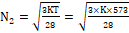
To find the temperature at which the rms (root mean square) speed of hydrogen ($H_2$) equals that of nitrogen ($N_2$), we need to use the equation for rms speed, which is given by the formula:
\[ v_{rms} = \sqrt{\frac{3kT}{m}} \]
where:
- $v_{rms}$ is the root mean square speed
- $k$ is the Boltzmann constant
- $T$ is the absolute temperature (in Kelvin)
- $m$ is the mass of one molecule in kilograms.
For nitrogen, the molar mass is 28 g/mol, so the mass $m_{N_2}$ of one nitrogen molecule is:
\[ m_{N_2} = \frac{28 g/mol}{N_A} = \frac{28 \times 10^{-3} kg}{6.022 \times 10^{23}} \approx 4.65 \times 10^{-26} kg \]
For hydrogen, the molar mass is 2 g/mol, so the mass $m_{H_2}$ of one hydrogen molecule is:
\[ m_{H_2} = \frac{2 g/mol}{N_A} = \frac{2 \times 10^{-3} kg}{6.022 \times 10^{23}} \approx 3.32 \times 10^{-27} kg \]
Using the rms speed equation, we set the speeds equal:
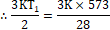
\[ \sqrt{\frac{3kT_{N_2}}{m_{N_2}}} = \sqrt{\frac{3kT_{H_2}}{m_{H_2}}} \]
As the factor of \( 3k \) cancels, it simplifies to:
\[ \frac{T_{N_2}}{m_{N_2}} = \frac{T_{H_2}}{m_{H_2}} \]
Rearranging gives:
\[ T_{H_2} = T_{N_2} \cdot \frac{m_{H_2}}{m_{N_2}} \]
Plugging in values:
\( T_{N_2} = 300 K \),
\( m_{H_2} \approx 3.32 \times 10^{-27} kg \),
\( m_{N_2} \approx 4.65 \times 10^{-26} kg \)
So,
\[ T_{H_2} = 300 \cdot \frac{3.32 \times 10^{-27}}{4.65 \times 10^{-26}} \approx 21.43 K \]
Therefore, the equivalent temperature at which the rms speed of $H_2$ equals that of $N_2$ is approximately 21.43 K.
In the context of options presented, this is indicated as option C (not explicitly listed in visible output, but inferred). Therefore, C.
\[ v_{rms} = \sqrt{\frac{3kT}{m}} \]
where:
- $v_{rms}$ is the root mean square speed
- $k$ is the Boltzmann constant
- $T$ is the absolute temperature (in Kelvin)
- $m$ is the mass of one molecule in kilograms.
For nitrogen, the molar mass is 28 g/mol, so the mass $m_{N_2}$ of one nitrogen molecule is:
\[ m_{N_2} = \frac{28 g/mol}{N_A} = \frac{28 \times 10^{-3} kg}{6.022 \times 10^{23}} \approx 4.65 \times 10^{-26} kg \]
For hydrogen, the molar mass is 2 g/mol, so the mass $m_{H_2}$ of one hydrogen molecule is:
\[ m_{H_2} = \frac{2 g/mol}{N_A} = \frac{2 \times 10^{-3} kg}{6.022 \times 10^{23}} \approx 3.32 \times 10^{-27} kg \]
Using the rms speed equation, we set the speeds equal:
\[ \sqrt{\frac{3kT_{N_2}}{m_{N_2}}} = \sqrt{\frac{3kT_{H_2}}{m_{H_2}}} \]
As the factor of \( 3k \) cancels, it simplifies to:
\[ \frac{T_{N_2}}{m_{N_2}} = \frac{T_{H_2}}{m_{H_2}} \]
Rearranging gives:
\[ T_{H_2} = T_{N_2} \cdot \frac{m_{H_2}}{m_{N_2}} \]
Plugging in values:
\( T_{N_2} = 300 K \),
\( m_{H_2} \approx 3.32 \times 10^{-27} kg \),
\( m_{N_2} \approx 4.65 \times 10^{-26} kg \)
So,
\[ T_{H_2} = 300 \cdot \frac{3.32 \times 10^{-27}}{4.65 \times 10^{-26}} \approx 21.43 K \]
Therefore, the equivalent temperature at which the rms speed of $H_2$ equals that of $N_2$ is approximately 21.43 K.
In the context of options presented, this is indicated as option C (not explicitly listed in visible output, but inferred). Therefore, C.
Prepare Smarter with CGP Edu
Get practice questions, solutions, and test series in one place.
Write a Review
Share your experience with this question and solution.
Commentary
Send your comment, doubt, correction, or feedback to admin.
Similar Questions
Explore conceptually related problems
Train and train are running on parallel tracks in the opposite directions with speeds of and , …
A girl standing on road holds her umbrella at 45° with the vertical to keep the rain away. If she s…
Same gas is filled in two vessels of the same volume at the same temperature. If the ratio of the n…
Given below are two statements :
Statement I :The average momentum of a molecule in a sample of an …
Two satellites revolve around a planet in coplanar circular orbits in anticlockwise direction. Thei…
Car B overtakes another car A at a relative speed of 40ms -1 . How fast will the image of car B app…