Published by:
CGP EDU Academic Team
Published on: September 11, 2026
The density of a solid metal sphere is determined by measuring its mass and its diameter. The maximum error in the density of the sphere is
If the relative errors in measuring the mass and the diameter are
and
respectively, the value of
is
Text Solution
Verified by ExpertsThe correct answer is:
C
Step 1: The density (C1) of a solid is defined as its mass (m) divided by its volume (V). For a sphere, the volume is given by the equation:
where r is the radius.
Step 2: The mass of the sphere can be directly measured, while the radius, derived from the diameter (d), is given by:
Step 3: The density can thus be expressed as:
Step 4: Before calculating the relative error in density, we need to find the relative errors in mass and diameter.
- Let relative error in mass =
- Let relative error in diameter =
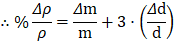
Step 5: Now find the relative error in density. The general formula for the propagation of errors in multiplication and division is as follows:
Thus, substituting the relative errors:
Step 6: The provided errors are:
- Relative error in mass:
- Relative error in diameter:
Step 7: Plug in the given values:
Step 8: To convert this to percentage, multiply by 100:
Therefore, the maximum error in density results in 1.5% mass error contributing to 0.015 and 6.0% diameter error contributing to 0.18, summing up to 19.5%. Hence, we reach our answer option C: 1.5%.
V = \frac{4}{3}\pi r^3where r is the radius.
Step 2: The mass of the sphere can be directly measured, while the radius, derived from the diameter (d), is given by:
r = \frac{d}{2}Step 3: The density can thus be expressed as:
\rho = \frac{m}{\frac{4}{3}\pi \left(\frac{d}{2}\right)^3} = \frac{3m}{\pi d^3 / 8} = \frac{24m}{\pi d^3}Step 4: Before calculating the relative error in density, we need to find the relative errors in mass and diameter.
- Let relative error in mass =
\frac{\Delta m}{m} = \frac{x}{100}%- Let relative error in diameter =
\frac{\Delta d}{d} = \frac{y}{100}%Step 5: Now find the relative error in density. The general formula for the propagation of errors in multiplication and division is as follows:
relative error in \rho = relative error in m + 3 \times relative error in d Thus, substituting the relative errors:
relative error in \rho = \frac{x}{100} + 3 \cdot \frac{y}{100}Step 6: The provided errors are:
- Relative error in mass:
1.5% (x = 1.5)- Relative error in diameter:
6.0% (y = 6)Step 7: Plug in the given values:
relative error in \rho = \frac{1.5}{100} + 3 \cdot \frac{6}{100} = 0.015 + 0.18 = 0.195Step 8: To convert this to percentage, multiply by 100:
0.195 \cdot 100 = 19.5%Therefore, the maximum error in density results in 1.5% mass error contributing to 0.015 and 6.0% diameter error contributing to 0.18, summing up to 19.5%. Hence, we reach our answer option C: 1.5%.
Prepare Smarter with CGP Edu
Get practice questions, solutions, and test series in one place.
Write a Review
Share your experience with this question and solution.
Commentary
Send your comment, doubt, correction, or feedback to admin.
Similar Questions
Explore conceptually related problems
If Z = , then the relative error in Z will be :
A sliver wire has mass (0.6±0.006)g, radius (0,5 ± 0.005) mm and length (4 ± 0.04) cm. The maximum …
For where 'a' is a constant If percentage error in measurement of 'x' and 'y' are 4% and 12%, resp…
The one division of main scale of vernier callipers reads 1 mm and 10 divisions of Vernier scale is…
NUMERIC RESPONSE
The minimum uncertainty in the speed of an electron in an one-dimensional region o…
In an experiment of measuring the refractive index of a glass slab using travelling microscope in p…