Published by:
CGP EDU Academic Team
Published on: September 13, 2026
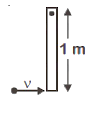
A thin rod of mass 0.9kg and length 1m is suspended, at rest, from one end so that it can freely oscillate in the vertical plane. A particle of move 0.1kg moving in a straight line with velocity 80m/s hits the rod at its bottom most point and sticks to it (see figure). The angular speed (in rad/s) of the rodimmediately after the collision will be
Text Solution
Verified by ExpertsThe correct answer is:
A
Step 1: Identify the parameters involved. The mass of the rod, $m_{rod} = 0.9 ext{ kg}$, and its length, $L = 1 ext{ m}$. The mass of the particle, $m_{particle} = 0.1 ext{ kg}$, and its velocity before the collision, $v = 80 ext{ m/s}$.
Step 2: Calculate the moment of inertia of the rod about the pivot point (end of the rod). The moment of inertia $I_{rod}$ is given by:
$$ I_{rod} = \frac{1}{3} m_{rod} L^2 = \frac{1}{3} (0.9) (1^2) = 0.3 ext{ kg m}^2 $$
Step 3: Calculate the moment of inertia of the particle about the pivot point. The particle sticks at the bottom of the rod, which is 1 m away from the pivot point. Thus, the moment of inertia $I_{particle}$ is:
$$ I_{particle} = m_{particle} r^2 = 0.1 (1)^2 = 0.1 ext{ kg m}^2 $$
Step 4: Calculate the total moment of inertia $I_{total}$ after collision:
$$ I_{total} = I_{rod} + I_{particle} = 0.3 + 0.1 = 0.4 ext{ kg m}^2 $$
Step 5: Use conservation of angular momentum. The initial angular momentum of the system before the collision (only the particle contributes) is given by:
$$ L_{initial} = m_{particle} v r = 0.1 imes 80 imes 1 = 8 ext{ kg m}^2/s $$
Step 6: The angular momentum after the collision is given by:
$$ L_{final} = I_{total} \omega $$
Setting initial angular momentum equal to final angular momentum gives us:
$$ 8 = 0.4 \omega $$
Step 7: Solving for \omega:
$$ \omega = \frac{8}{0.4} = 20 ext{ rad/s} $$
Therefore, the angular speed of the rod immediately after the collision is 20 rad/s.
Step 2: Calculate the moment of inertia of the rod about the pivot point (end of the rod). The moment of inertia $I_{rod}$ is given by:
$$ I_{rod} = \frac{1}{3} m_{rod} L^2 = \frac{1}{3} (0.9) (1^2) = 0.3 ext{ kg m}^2 $$
Step 3: Calculate the moment of inertia of the particle about the pivot point. The particle sticks at the bottom of the rod, which is 1 m away from the pivot point. Thus, the moment of inertia $I_{particle}$ is:
$$ I_{particle} = m_{particle} r^2 = 0.1 (1)^2 = 0.1 ext{ kg m}^2 $$
Step 4: Calculate the total moment of inertia $I_{total}$ after collision:
$$ I_{total} = I_{rod} + I_{particle} = 0.3 + 0.1 = 0.4 ext{ kg m}^2 $$
Step 5: Use conservation of angular momentum. The initial angular momentum of the system before the collision (only the particle contributes) is given by:
$$ L_{initial} = m_{particle} v r = 0.1 imes 80 imes 1 = 8 ext{ kg m}^2/s $$
Step 6: The angular momentum after the collision is given by:
$$ L_{final} = I_{total} \omega $$
Setting initial angular momentum equal to final angular momentum gives us:
$$ 8 = 0.4 \omega $$
Step 7: Solving for \omega:
$$ \omega = \frac{8}{0.4} = 20 ext{ rad/s} $$
Therefore, the angular speed of the rod immediately after the collision is 20 rad/s.
Prepare Smarter with CGP Edu
Get practice questions, solutions, and test series in one place.
Write a Review
Share your experience with this question and solution.
Commentary
Send your comment, doubt, correction, or feedback to admin.
Similar Questions
Explore conceptually related problems
Consider a uniform rod of mass and length pivoted about its centre. A mass moving with velocity …
A particle moving in the xy plane experiences a velocity dependent force where and are the x and…
A spaceship in space sweeps stationary interplanetary dust. As a result, its mass increases at a ra…
In an experiment to verify Stokes law, a small spherical ball of radius r and density falls under …
A body of mass M at rest explodes into three pieces, in the ratio of masses 1:1:2. Two smaller piec…
A batsman hits back a ball of mass 0.4 kg straight in the direction of the bowler without changing …