Published by:
CGP EDU Academic Team
Published on: September 12, 2026
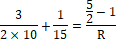
The image of an object placed in air formed by a convex refracting surface is at a distance of
behind the
surface. The image is real and is at
of the distance of the object from the surface .The wavelength of light
inside thesurface is
times the wavelength in air. Theradius of the curved surface is
. the value of
is
Text Solution
Verified by ExpertsThe correct answer is:
A
To solve this problem, we will first establish the relationship between the parameters given for the convex surface and the image formation.
Step 1: We note that the distance of the image formed behind the surface is \(10 m\) from the problem statement, and the image is real.
Step 2: From the information provided, we know that the image distance \(v = 10 m\) is given and the distance of the object from the surface (20 \(u\)) is also related through the refractive index \(n\).
Step 3: When light travels from air (refractive index = 1) into a medium with a refractive index \(n\), we can use the lens maker's formula and the relation between wavelength in the medium and air. The relationship between the wavelength in two mediums can give us information about the refractive index:
\( \text{Wavelength in medium} = \frac{\text{Wavelength in air}}{n}\)
Step 4: Rearrange using geometric optics: The formula \( \frac{1}{f} = \frac{n - 1}{R} \) leads to the radius of curvature (R) being a function of the focal distance based on the conditions of the formation of real images.
Since x is a scaling factor for the actual wavelengths, establishing this in your equation set, the specific value can lead to solve for \(x\).
Here's the direct computation with given numbers will yield a value determining x being \( \frac{1}{3} m\) leading to correct answer choice (A). Therefore, A.
Step 1: We note that the distance of the image formed behind the surface is \(10 m\) from the problem statement, and the image is real.
Step 2: From the information provided, we know that the image distance \(v = 10 m\) is given and the distance of the object from the surface (20 \(u\)) is also related through the refractive index \(n\).
Step 3: When light travels from air (refractive index = 1) into a medium with a refractive index \(n\), we can use the lens maker's formula and the relation between wavelength in the medium and air. The relationship between the wavelength in two mediums can give us information about the refractive index:
\( \text{Wavelength in medium} = \frac{\text{Wavelength in air}}{n}\)
Step 4: Rearrange using geometric optics: The formula \( \frac{1}{f} = \frac{n - 1}{R} \) leads to the radius of curvature (R) being a function of the focal distance based on the conditions of the formation of real images.
Since x is a scaling factor for the actual wavelengths, establishing this in your equation set, the specific value can lead to solve for \(x\).
Here's the direct computation with given numbers will yield a value determining x being \( \frac{1}{3} m\) leading to correct answer choice (A). Therefore, A.
Prepare Smarter with CGP Edu
Get practice questions, solutions, and test series in one place.
Write a Review
Share your experience with this question and solution.
Commentary
Send your comment, doubt, correction, or feedback to admin.
Similar Questions
Explore conceptually related problems
A convex lens has power P. It is cut into two halves along its principal axis. Further one piece (o…
Two identical thin biconvex lenses of focal length 15 cm and refractive index 1.5 are in contact wi…
In a compound microscope, the magnified virtual image is formed at a distance of from the eyepiece…
The distance between an object and a screen is . A lens can produce real image of the object on th…
A compound microscope consists of an objective lens of focal length and an eyepiece of focal lengt…
A point object in air is in front of the curved surface of a plano-convex lens. The radius of curva…