Published by:
CGP EDU Academic Team
Published on: September 12, 2026
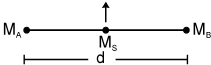
Two planets A and B are fixed at a distance d from each other as shown in the figure. If the mass of A is M A and that of B is M B , then find out the minimum velocity of a satellite of mass M S projected from the mid point of two planets to infinity.
Text Solution
Verified by ExpertsThe correct answer is:
A
Step 1: Understand the system
We have two planets A and B with masses $M_A$ and $M_B$, respectively, separated by a distance $d$. A satellite of mass $M_S$ is projected from the midpoint between the two planets.
Step 2: Determine the gravitational forces
At the midpoint (distance $\frac{d}{2}$ from both planets), the gravitational forces acting on the satellite due to both planets can be calculated using Newton's law of gravitation:
$$F_A = \frac{G M_A M_S}{(\frac{d}{2})^2} = \frac{4 G M_A M_S}{d^2}$$
$$F_B = \frac{G M_B M_S}{(\frac{d}{2})^2} = \frac{4 G M_B M_S}{d^2}$$
Where $G$ is the universal gravitational constant.
Step 3: Net gravitational force at the midpoint
The net force acting on the satellite is directed towards the larger mass. Hence, if $M_A > M_B$:
$$F_{net} = F_A - F_B = \frac{4 G M_A M_S}{d^2} - \frac{4 G M_B M_S}{d^2} = \frac{4 G M_S (M_A - M_B)}{d^2}$$
Step 4: Gravitational potential energy
The potential energy of the satellite when projected from the midpoint to infinity can be written as:
$$U_{initial} = -\frac{G M_A M_S}{\frac{d}{2}} - \frac{G M_B M_S}{\frac{d}{2}} = -\frac{2 G M_A M_S}{d} - \frac{2 G M_B M_S}{d} = -\frac{2 G M_S (M_A + M_B)}{d}$$
Step 5: Energy conservation
To escape the gravitational pull of both planets to infinity, the total mechanical energy (kinetic + potential) must be zero:
$$K + U_{initial} = 0$$
Where the kinetic energy ($K$) is given by: $$K = \frac{1}{2} M_S v^2$$
Setting the energies equal: $$\frac{1}{2} M_S v^2 - \frac{2 G M_S (M_A + M_B)}{d} = 0$$
Step 6: Solve for minimum velocity
Solving for $v$:
$$\frac{1}{2} M_S v^2 = \frac{2 G M_S (M_A + M_B)}{d}$$
Cancelling out $M_S$ from both sides (as long as $M_S \neq 0$):
$$\frac{1}{2} v^2 = \frac{2 G (M_A + M_B)}{d}$$
Thus, we find
$$v^2 = \frac{4 G (M_A + M_B)}{d}$$
Giving us:
$$v = \sqrt{\frac{4 G (M_A + M_B)}{d}}$$
Hence, the minimum velocity required for the satellite to escape to infinity is:
$$v_{min} = \sqrt{\frac{4G (M_A + M_B)}{d}}$$
Therefore, the answer is option A.
We have two planets A and B with masses $M_A$ and $M_B$, respectively, separated by a distance $d$. A satellite of mass $M_S$ is projected from the midpoint between the two planets.
Step 2: Determine the gravitational forces
At the midpoint (distance $\frac{d}{2}$ from both planets), the gravitational forces acting on the satellite due to both planets can be calculated using Newton's law of gravitation:
$$F_A = \frac{G M_A M_S}{(\frac{d}{2})^2} = \frac{4 G M_A M_S}{d^2}$$
$$F_B = \frac{G M_B M_S}{(\frac{d}{2})^2} = \frac{4 G M_B M_S}{d^2}$$
Where $G$ is the universal gravitational constant.
Step 3: Net gravitational force at the midpoint
The net force acting on the satellite is directed towards the larger mass. Hence, if $M_A > M_B$:
$$F_{net} = F_A - F_B = \frac{4 G M_A M_S}{d^2} - \frac{4 G M_B M_S}{d^2} = \frac{4 G M_S (M_A - M_B)}{d^2}$$
Step 4: Gravitational potential energy
The potential energy of the satellite when projected from the midpoint to infinity can be written as:
$$U_{initial} = -\frac{G M_A M_S}{\frac{d}{2}} - \frac{G M_B M_S}{\frac{d}{2}} = -\frac{2 G M_A M_S}{d} - \frac{2 G M_B M_S}{d} = -\frac{2 G M_S (M_A + M_B)}{d}$$
Step 5: Energy conservation
To escape the gravitational pull of both planets to infinity, the total mechanical energy (kinetic + potential) must be zero:
$$K + U_{initial} = 0$$
Where the kinetic energy ($K$) is given by: $$K = \frac{1}{2} M_S v^2$$
Setting the energies equal: $$\frac{1}{2} M_S v^2 - \frac{2 G M_S (M_A + M_B)}{d} = 0$$
Step 6: Solve for minimum velocity
Solving for $v$:
$$\frac{1}{2} M_S v^2 = \frac{2 G M_S (M_A + M_B)}{d}$$
Cancelling out $M_S$ from both sides (as long as $M_S \neq 0$):
$$\frac{1}{2} v^2 = \frac{2 G (M_A + M_B)}{d}$$
Thus, we find
$$v^2 = \frac{4 G (M_A + M_B)}{d}$$
Giving us:
$$v = \sqrt{\frac{4 G (M_A + M_B)}{d}}$$
Hence, the minimum velocity required for the satellite to escape to infinity is:
$$v_{min} = \sqrt{\frac{4G (M_A + M_B)}{d}}$$
Therefore, the answer is option A.
Prepare Smarter with CGP Edu
Get practice questions, solutions, and test series in one place.
Write a Review
Share your experience with this question and solution.
Commentary
Send your comment, doubt, correction, or feedback to admin.
Similar Questions
Explore conceptually related problems
A body of mass m is taken from earth surface to the height h equal to radius of earth, the increase…
An artificial satellite moving in a circular orbit around the earth has a total (kinetic + potentia…
On the x -axis and at a distance from the origin, the gravitational field due to a mass distributi…
The value of the acceleration due to gravity is at a height radius of the earth) from the surface…
The acceleration due to gravity on the earth's surface at the poles is and angular velocity of the…
A hollow spherical shell at outer radius R floats just submerged under the water surface. The inner…