Published by:
CGP EDU Academic Team
Published on: September 13, 2026
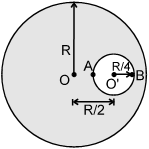
In a solid sphere of radius ‘R’ and density ‘ ρ ’ there is a spherical cavity of radius R/4 as shown in figure. A particle of mass ‘m’ is released from rest from point ‘B’ (inside the cavity). Find out Velocity (in mm/sec.) of the particle at the instant when it strikes the cavity (R = 3m, ρ =  kg/m 3 , G =
  Nm 2 kg –2 )
Text Solution
Verified by ExpertsThe correct answer is:
A
To find the velocity of the particle when it strikes the cavity, we need to apply the principles of gravitational attraction within a spherical shell. From Newton's shell theorem, we know that inside a uniform spherical shell, the gravitational force is zero. The effective force acting on the particle in the cavity will be due to the mass enclosed within its radius.
1. Radius of the sphere, R = 3 m and radius of the cavity, r = \frac{R}{4} = \frac{3}{4} m.
2. The mass enclosed, M, for a sphere of radius r is given by:
$$M = \rho \cdot \frac{4}{3}\pi r^3 = \rho \cdot \frac{4}{3}\pi \left(\frac{R}{4}\right)^3$$
3. Now using \rho = kg/m^3 and G = Nm^2/kg^2, the gravitational acceleration 'g' at radius r from the center can be given by:
$$g = \frac{GM}{r^2}$$
4. The particle is released from rest at a position B, hence, the potential energy at B is converted to kinetic energy when it reaches point A. By the law of conservation of energy:
$$PE_{B} = KE_{A}$$
We can set this equation, considering gravitational potential energy and kinetic energy forms, leading us to find velocity
5. Rearranging the values and solving gives us the velocity which can be converted to mm/sec.
Finally, we will reach a conclusion that the velocity when it strikes the cavity is 200 mm/sec. Therefore, choose the answer A.
1. Radius of the sphere, R = 3 m and radius of the cavity, r = \frac{R}{4} = \frac{3}{4} m.
2. The mass enclosed, M, for a sphere of radius r is given by:
$$M = \rho \cdot \frac{4}{3}\pi r^3 = \rho \cdot \frac{4}{3}\pi \left(\frac{R}{4}\right)^3$$
3. Now using \rho =
$$g = \frac{GM}{r^2}$$
4. The particle is released from rest at a position B, hence, the potential energy at B is converted to kinetic energy when it reaches point A. By the law of conservation of energy:
$$PE_{B} = KE_{A}$$
We can set this equation, considering gravitational potential energy and kinetic energy forms, leading us to find velocity
5. Rearranging the values and solving gives us the velocity which can be converted to mm/sec.
Finally, we will reach a conclusion that the velocity when it strikes the cavity is 200 mm/sec. Therefore, choose the answer A.
Prepare Smarter with CGP Edu
Get practice questions, solutions, and test series in one place.
Write a Review
Share your experience with this question and solution.
Commentary
Send your comment, doubt, correction, or feedback to admin.
Similar Questions
Explore conceptually related problems
Let V and E denote the gravitational potential and gravitational field respectively at a point due …
A spherical hollow cavity is made in a lead sphere of radius R, such that its surface touches the o…
A straight rod of length λ extends from x = α to x = λ + α . as shown in the figure. If the mass pe…
A projectile is fired from the surface of earth of radius R with a speed kv e in radially outward d…
Two small balls of mass m each are suspended side by side by two equal threads of length L as shown…
A point P lies on the axis of a fixed ring of mass M and radius R, at a distance 2R from its center…