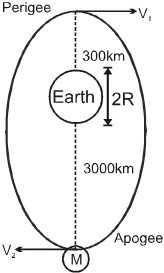
Consider a spacecraft in an elliptical orbit around the earth. At the lowest point or perigee, of its orbit it is 300 km above the earth’s surface at the highest point or apogee, it is 3000 km above the earth’s surface.
Text Solution
Verified by ExpertsCHECK THE SOLUTION.
T =  = 7.16 × × 10 3 sec.
 =
=  = 1.4
= 1.4
V p = 896×10 2  m/sec. = 8.35 × × 10 3 m/s,
V a = 896×10 2  m/sec = 5.95 × × 10 3 m/s
Δ V = 14× 10 2  – V P = 3.09 × × 10 3 m/s, perigee
Sol. Total distance from apogee to perigee
300 + 2(6400) + 3000 = 2a
a = 8050 km
Time period of the spacecraft
T 2 = 
T =  =
= 
T =  =
= 
Apply angular momentum conservation about the center of earth, between perigee and Apogee.
mv 1 r min = m v 2 r max .............(i)
(v 1 ) (300 + 6400) = v 2 (3000 + 6400)
 =
= 
Also apply energy conservation between perigee an Apogee
 mv 1 2 +
  =
=  mv 2 2 +
  .............(ii)
Where tgk¡ r min = (300 + 6400)km and r max = (3000 + 6400)km
From eqn. (i) & (ii) we get
v 1 = 8.35 × 10 3 m/sec
v 2 = 5.95 × 10 3 m/sec.
To escape, velocity at r → ∞ should be zero.
Applying energy conservation between perigee and r → ∞ .
ki + U = k f + U f
 mv 1 2 +
  = 0 + 0
v 1 = 11.44 × 10 3 m/sec.
Increase in speed = 11.44 × 10 3 – 8.35 × 10 3
= 3.09 × 10 3 m/sec.
Prepare Smarter with CGP Edu
Get practice questions, solutions, and test series in one place.
Write a Review
Share your experience with this question and solution.
Commentary
Send your comment, doubt, correction, or feedback to admin.
Similar Questions
Explore conceptually related problems