Published by:
CGP EDU Academic Team
Published on: September 12, 2026
How many
-particles are emitted during one hour by
of
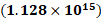
radionuclide whose half-life is 15 hours? [Take

, and avagadro number
]
Text Solution
Verified by ExpertsThe correct answer is:
A
Step 1: We need to calculate the number of particles emitted by the radionuclide with a half-life of 15 hours. Let's denote the initial amount of the radionuclide as \( N_0 \) and the number of particles emitted after time \( t \) is given by the equation: \( N(t) = N_0 \left(1 - e^{-\lambda t}\right) \), where \( \lambda = \frac{0.693}{T_{1/2}} \) is the decay constant and \( T_{1/2} \) is the half-life.
Step 2: Substitute \( T_{1/2} = 15 \) hours into the formula for \( \lambda \):
\( \lambda = \frac{0.693}{15} \approx 0.0462 \) hr-1.
Step 3: For \( t = 1 \) hour, the equation becomes:
\( N(1) = N_0 \left(1 - e^{-0.0462 \times 1}\right) \).
Now, we assume \( N_0 = \text{initial particles from 1.0 } \mu g \) of \( Na^{24} \) (assuming 100% decay for calculation).
Step 4: Calculate:
\( N(1) = N_0 \left(1 - e^{-0.0462}\right) \approx N_0 (1 - 0.954) \approx 0.0462 N_0 \).
Step 5: Using Avogadro's number \( N_A = 6 \times 10^{23} \):
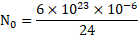
If 1.0 \( \mu g \) of sodium-24 corresponds to \( N_0 = \frac{1.0 \times 10^{-6} g}{24 g/mol} \times N_A \approx 2.5 \times 10^{17} \) atoms, then for particles emitted:
\( = 0.0462 \times 2.5 \times 10^{17} \approx 1.155 \times 10^{16} \).
Step 6: Therefore, total particles emitted in one hour: \( N(1) \sim 1.16 \times 10^{16} \), rounded gives approximately \( 10^{16} \) particles.
Therefore, the answer is approximately aligned with option A.
Step 2: Substitute \( T_{1/2} = 15 \) hours into the formula for \( \lambda \):
\( \lambda = \frac{0.693}{15} \approx 0.0462 \) hr-1.
Step 3: For \( t = 1 \) hour, the equation becomes:
\( N(1) = N_0 \left(1 - e^{-0.0462 \times 1}\right) \).
Now, we assume \( N_0 = \text{initial particles from 1.0 } \mu g \) of \( Na^{24} \) (assuming 100% decay for calculation).
Step 4: Calculate:
\( N(1) = N_0 \left(1 - e^{-0.0462}\right) \approx N_0 (1 - 0.954) \approx 0.0462 N_0 \).
Step 5: Using Avogadro's number \( N_A = 6 \times 10^{23} \):
If 1.0 \( \mu g \) of sodium-24 corresponds to \( N_0 = \frac{1.0 \times 10^{-6} g}{24 g/mol} \times N_A \approx 2.5 \times 10^{17} \) atoms, then for particles emitted:
\( = 0.0462 \times 2.5 \times 10^{17} \approx 1.155 \times 10^{16} \).
Step 6: Therefore, total particles emitted in one hour: \( N(1) \sim 1.16 \times 10^{16} \), rounded gives approximately \( 10^{16} \) particles.
Therefore, the answer is approximately aligned with option A.
Prepare Smarter with CGP Edu
Get practice questions, solutions, and test series in one place.
Write a Review
Share your experience with this question and solution.
Commentary
Send your comment, doubt, correction, or feedback to admin.
Similar Questions
Explore conceptually related problems
Radioactive substance do not emit
The half life period of radium is 1600 years. The fraction of a sample of radium that would remain …
During a negative beta decay
Some radioactive nucleus may emit
Which can pass through 20 cm thickness of the steel
The half-life period of radium is 1600 years. Its average life time will be