Published by:
CGP EDU Academic Team
Published on: September 12, 2026
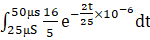
A 5.0 µF capacitor having a charge of 20 µC is discharged through a wire of resistance 5.0 Ω . Find the heat dissipated in the wire between 25 to 50 µs after the connections are made. (Given: e – 2 = 0.135)
Text Solution
Verified by ExpertsThe correct answer is:
B
Step 1: The voltage across the capacitor (V) can be calculated using the formula: \( V = \frac{Q}{C} \) where \( Q = 20 \mu C \) and \( C = 5.0 \mu F \). Hence, \( V = \frac{20 \times 10^{-6}}{5.0 \times 10^{-6}} = 4 \text{ V} \).
Step 2: The energy stored in the capacitor (E) is given by: \( E = \frac{1}{2} C V^2 \). Substituting the known values, \( E = \frac{1}{2} \times 5.0 \times 10^{-6} \times (4)^2 = 0.00004 \text{ J} = 40 \mu J \).
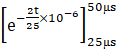
Step 3: When the capacitor discharges through the resistor, the heat dissipated (Q) by the resistor can be calculated over the discharge time. The voltage drop over time can be represented as: \( V(t) = V_0 e^{-\frac{t}{RC}} \) where \( R = 5.0 \Omega \) and \( C = 5.0 \mu F \) gives \( RC = 5.0 \cdot 5.0 \times 10^{-6} = 25 \times 10^{-6} \text{ s} \) or 25 µs.
Step 4: The voltage after 25 µs and 50 µs can be calculated as:
- For 25 µs: \( V(25) = 4 e^{-1} \) (since \( \frac{25 \times 10^{-6}}{25 \times 10^{-6}} = 1 \)) results in \( V(25) = 4 \times 0.368 = 1.472 \text{ V} \).
- For 50 µs: \( V(50) = 4 e^{-2} \) results in \( V(50) = 4 \times 0.135 = 0.54 \text{ V} \).
Step 5: The energy dissipated between these times in the resistor can now be calculated as:
\( Q_{dissipated} = I^2 R \Delta t \) with \( I = \frac{V(t)}{R} \).
For \( t = 25 \mu s \): \( I_{25} = \frac{1.472}{5.0} = 0.2944 \text{ A} \) leading to \( Q_{dissipated(25)} = (0.2944^2)(5)(25 \times 10^{-6}) = 0.00022 \text{ J} \).
For \( t = 50 \mu s \): \( I_{50} = \frac{0.54}{5.0} = 0.108 \text{ A} \) leading to \( Q_{dissipated(50)} = (0.108^2)(5)(25 \times 10^{-6}) = 0.00001459 \text{ J} \).
Step 6: The total heat dissipated in that interval would be \( Q_{dissipated} = Q_{dissipated(25)} - Q_{dissipated(50)} = 0.00022 - 0.00001459 = 0.00020541 \text{ J} or approximately 0.2054 mJ.
Therefore, the correct answer is approximately 0.205 mJ.
Step 2: The energy stored in the capacitor (E) is given by: \( E = \frac{1}{2} C V^2 \). Substituting the known values, \( E = \frac{1}{2} \times 5.0 \times 10^{-6} \times (4)^2 = 0.00004 \text{ J} = 40 \mu J \).
Step 3: When the capacitor discharges through the resistor, the heat dissipated (Q) by the resistor can be calculated over the discharge time. The voltage drop over time can be represented as: \( V(t) = V_0 e^{-\frac{t}{RC}} \) where \( R = 5.0 \Omega \) and \( C = 5.0 \mu F \) gives \( RC = 5.0 \cdot 5.0 \times 10^{-6} = 25 \times 10^{-6} \text{ s} \) or 25 µs.
Step 4: The voltage after 25 µs and 50 µs can be calculated as:
- For 25 µs: \( V(25) = 4 e^{-1} \) (since \( \frac{25 \times 10^{-6}}{25 \times 10^{-6}} = 1 \)) results in \( V(25) = 4 \times 0.368 = 1.472 \text{ V} \).
- For 50 µs: \( V(50) = 4 e^{-2} \) results in \( V(50) = 4 \times 0.135 = 0.54 \text{ V} \).
Step 5: The energy dissipated between these times in the resistor can now be calculated as:
\( Q_{dissipated} = I^2 R \Delta t \) with \( I = \frac{V(t)}{R} \).
For \( t = 25 \mu s \): \( I_{25} = \frac{1.472}{5.0} = 0.2944 \text{ A} \) leading to \( Q_{dissipated(25)} = (0.2944^2)(5)(25 \times 10^{-6}) = 0.00022 \text{ J} \).
For \( t = 50 \mu s \): \( I_{50} = \frac{0.54}{5.0} = 0.108 \text{ A} \) leading to \( Q_{dissipated(50)} = (0.108^2)(5)(25 \times 10^{-6}) = 0.00001459 \text{ J} \).
Step 6: The total heat dissipated in that interval would be \( Q_{dissipated} = Q_{dissipated(25)} - Q_{dissipated(50)} = 0.00022 - 0.00001459 = 0.00020541 \text{ J} or approximately 0.2054 mJ.
Therefore, the correct answer is approximately 0.205 mJ.
Prepare Smarter with CGP Edu
Get practice questions, solutions, and test series in one place.
Write a Review
Share your experience with this question and solution.
Commentary
Send your comment, doubt, correction, or feedback to admin.
Similar Questions
Explore conceptually related problems
The capacity of a parallel plate condenser is . When a glass plate is placed between the plates of…
A capacitor is charged by using a battery which is then disconnected. A dielectric slab is then sli…
The energy of a charged capacitor is given by the expression ( $\alpha$ = charge on the conductor a…
The capacity of a condenser is $4 \times 10^{-6}$ farad and its potential is 100 volts . The energy…
The insulated spheres of radii $R_1$ and $R_2$ having charges $Q_1$ and $Q_2$ respectively are conn…
In a charged capacitor, the energy resides