Published by:
CGP EDU Academic Team
Published on: September 12, 2026
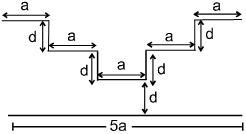
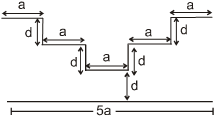
A capacitor is made of a flat plate of area A and a second plate having a stair-like structure as shown in figure. The width of each stair is a and the height is d. Both plates have the same width perpendicular to plane of paper. Find the capacitance of the assembly.
Text Solution
Verified by ExpertsThe correct answer is:
A
Step 1: Analyze the structure of the capacitor
The capacitor consists of a flat bottom plate with area $5a \cdot w$ (where $w$ is the width of the plates) and a stair-like top plate. The total height of the stair-like structure is $d$ and it has alternating heights and widths as shown.
Step 2: Calculate the effective area
The top plate can be thought to consist of several steps. Each step has a width of $a$ and a height of $d$. The effective area of the top plate ($A_{top}$) can be calculated as:
$$ A_{top} = n \cdot a \cdot d$$, where $n$ is the total number of steps.
Since the total width of the bottom plate is $5a$, the number of steps $(n)$ can be determined by examining the pattern of the stairs. There are effectively $5$ steps visible, each contributing to the top plate area.
Step 3: Determine the capacitance formula
The capacitance ($C$) of a capacitor is given by the formula:
$$ C = \frac{\varepsilon A}{d_{eff}}$$
where $A$ is the overlapping area between the plates and $d_{eff}$ is the distance between the plates. Since each segment has a height of $d$, the effective separation remains as $d$.
Step 4: Calculate total capacitance
Now substituting $A_{top}$ and the distance between plates into the capacitance formula gives us:
$$ C = \frac{\varepsilon (5ad)}{d} = 5\varepsilon a$$
Thus, each combination of areas adds up, giving the final answer as:
Therefore, the capacitance of the assembly is:
$$ C = 5\varepsilon a $$.
The capacitor consists of a flat bottom plate with area $5a \cdot w$ (where $w$ is the width of the plates) and a stair-like top plate. The total height of the stair-like structure is $d$ and it has alternating heights and widths as shown.
Step 2: Calculate the effective area
The top plate can be thought to consist of several steps. Each step has a width of $a$ and a height of $d$. The effective area of the top plate ($A_{top}$) can be calculated as:
$$ A_{top} = n \cdot a \cdot d$$, where $n$ is the total number of steps.
Since the total width of the bottom plate is $5a$, the number of steps $(n)$ can be determined by examining the pattern of the stairs. There are effectively $5$ steps visible, each contributing to the top plate area.
Step 3: Determine the capacitance formula
The capacitance ($C$) of a capacitor is given by the formula:
$$ C = \frac{\varepsilon A}{d_{eff}}$$
where $A$ is the overlapping area between the plates and $d_{eff}$ is the distance between the plates. Since each segment has a height of $d$, the effective separation remains as $d$.
Step 4: Calculate total capacitance
Now substituting $A_{top}$ and the distance between plates into the capacitance formula gives us:
$$ C = \frac{\varepsilon (5ad)}{d} = 5\varepsilon a$$
Thus, each combination of areas adds up, giving the final answer as:
Therefore, the capacitance of the assembly is:
$$ C = 5\varepsilon a $$.
Prepare Smarter with CGP Edu
Get practice questions, solutions, and test series in one place.
Write a Review
Share your experience with this question and solution.
Commentary
Send your comment, doubt, correction, or feedback to admin.
Similar Questions
Explore conceptually related problems
Assume that an electric field exists in space. Then the potential difference V A – V O , where V O…
A long cylindrical shell carries positive surface charge σ in the upper half and negative surface c…
An electric dipole has a fixed dipole moment , which makes angle θ with respect to x-axis. When su…
<p>Three concentric metal shells A, B and C of respective radii a, b and c (a < b < c) have s…
Assume that an electric field exists in space. Then the potential difference V A – V O , where V O…
An electric dipole has a fixed dipole moment , which makes angle θ with respect to x-axis. When su…