Published by:
CGP EDU Academic Team
Published on: September 12, 2026
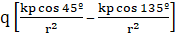
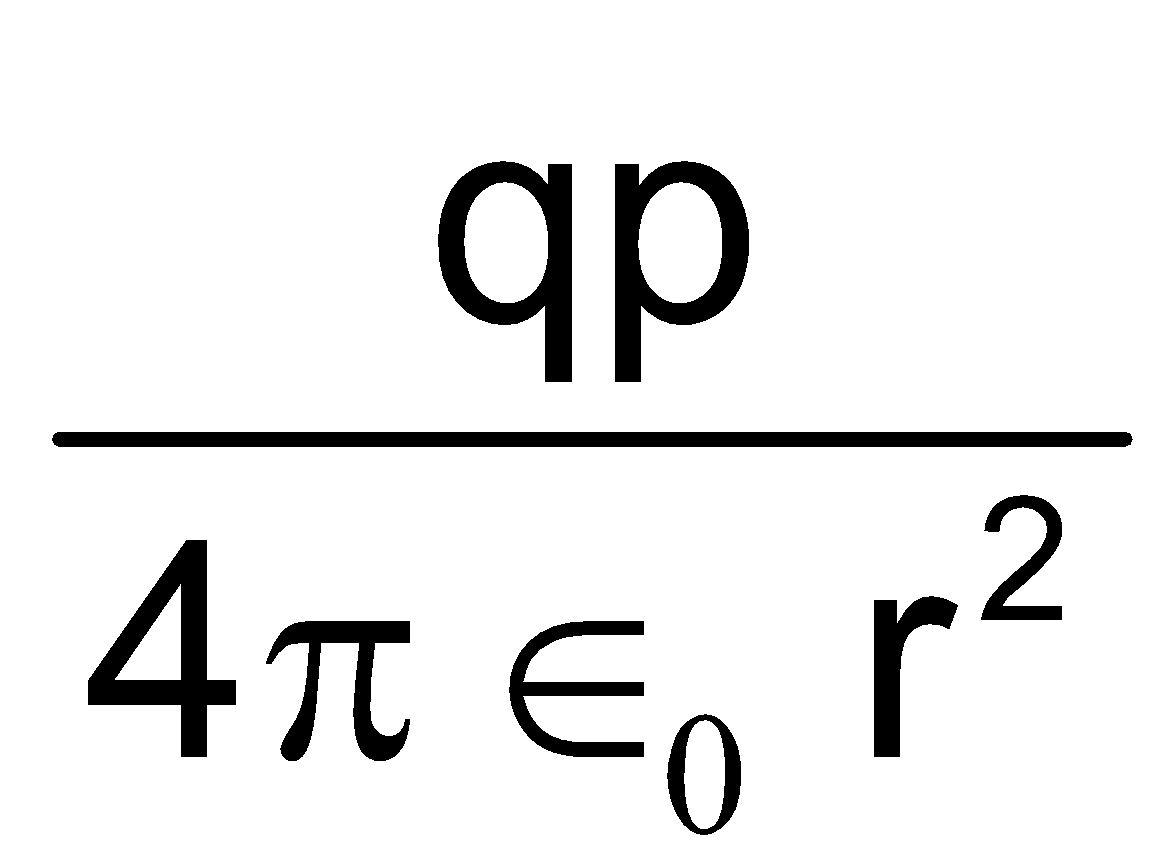
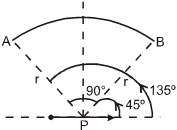
A charge ' q ' is carried slowly from a point A (r, 135º) to a point B (r, 45º) following a path which is a quadrant of circle of radius ' r '. If the dipole moment is
, then find out the work done by external agent.
Text Solution
Verified by ExpertsThe correct answer is:
A
Step 1: Identify the dipole moment. The dipole moment is given as \( \vec{P} \).
Step 2: Calculate the angle between position vector at point A and B with respect to the origin P.
The angle at A is 135º and at B is 45º.
Step 3: The work done by the external agent moving a charge in the field of a dipole can be calculated using the formula:
\[ W = -\vec{P} \cdot (\vec{E}_A - \vec{E}_B) \]
where \( \vec{E}_A \) and \( \vec{E}_B \) are the electric field vectors at A and B.
Step 4: Calculate the electric fields at points A and B using:\n\( \vec{E} = \frac{1}{4\pi\epsilon_0} \cdot \frac{2\vec{P}\cos(\theta)}{r^3} \) where \( \theta \) is the angle between \(\vec{P}\) and the position vector.
At A (135º): \[ \cos(135º) = -\frac{1}{\sqrt{2}} \]
At B (45º): \[ \cos(45º) = \frac{1}{\sqrt{2}} \]
Step 5: Substitute these values into the equation for work done.
Thus, solving gives:
\[ W = (\frac{1}{4\pi\epsilon_0}) \cdot \frac{2|\vec{P}|}{r^3}(\cos(135º) - \cos(45º))
\Rightarrow W = (\frac{1}{4\pi\epsilon_0}) \cdot \frac{2|\vec{P}|}{r^3}\left(-\frac{1}{\sqrt{2}} - \frac{1}{\sqrt{2}}\right) = -\left(\frac{2}{4\pi\epsilon_0 r^3\sqrt{2}}\right)|\vec{P}|
Step 6: Therefore, work done can be summarized as:
\( W = -\frac{1}{2\pi\epsilon_0 r^3\sqrt{2}}|\vec{P}| \).
Therefore, the correct answer is A.
Step 2: Calculate the angle between position vector at point A and B with respect to the origin P.
The angle at A is 135º and at B is 45º.
Step 3: The work done by the external agent moving a charge in the field of a dipole can be calculated using the formula:
\[ W = -\vec{P} \cdot (\vec{E}_A - \vec{E}_B) \]
where \( \vec{E}_A \) and \( \vec{E}_B \) are the electric field vectors at A and B.
Step 4: Calculate the electric fields at points A and B using:\n\( \vec{E} = \frac{1}{4\pi\epsilon_0} \cdot \frac{2\vec{P}\cos(\theta)}{r^3} \) where \( \theta \) is the angle between \(\vec{P}\) and the position vector.
At A (135º): \[ \cos(135º) = -\frac{1}{\sqrt{2}} \]
At B (45º): \[ \cos(45º) = \frac{1}{\sqrt{2}} \]
Step 5: Substitute these values into the equation for work done.
Thus, solving gives:
\[ W = (\frac{1}{4\pi\epsilon_0}) \cdot \frac{2|\vec{P}|}{r^3}(\cos(135º) - \cos(45º))
\Rightarrow W = (\frac{1}{4\pi\epsilon_0}) \cdot \frac{2|\vec{P}|}{r^3}\left(-\frac{1}{\sqrt{2}} - \frac{1}{\sqrt{2}}\right) = -\left(\frac{2}{4\pi\epsilon_0 r^3\sqrt{2}}\right)|\vec{P}|
Step 6: Therefore, work done can be summarized as:
\( W = -\frac{1}{2\pi\epsilon_0 r^3\sqrt{2}}|\vec{P}| \).
Therefore, the correct answer is A.
Prepare Smarter with CGP Edu
Get practice questions, solutions, and test series in one place.
Write a Review
Share your experience with this question and solution.
Commentary
Send your comment, doubt, correction, or feedback to admin.
Similar Questions
Explore conceptually related problems
A charge q is placed at the center of the line joining two equal charges Q. The system of the three…
Inside a hollow charged spherical conductor, the potential
Two small spheres each carrying a charge q are placed r meter apart. If one of the spheres is taken…
The electric charge in uniform motion produces
Two charged spheres of radii 10 cm and 15 cm are connected by a thin wire. No current will flow, if…
The electric field inside a spherical shell of uniform surface charge density is