Two masses ' m 1 ' and '  ' moving with velocities ' v 1 ' and ' v 2 ' in opposite directions collide elastically and after collision masses ' m 1 ' and ' m 2 ' move with velocity ' v 2 ' and ' v 1 ' respectively. The ratio
  is
is
Text Solution
Verified by ExpertsThe correct answer is:
C
:

As, 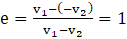
For perfectly elastic collision, 
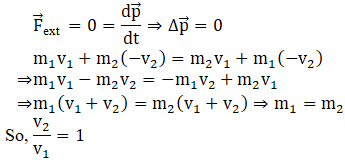
Also, for perfectly elastic collision, the two colliding bodies exchange their velocities i.e., they have same mass.
Prepare Smarter with CGP Edu
Get practice questions, solutions, and test series in one place.
Write a Review
Share your experience with this question and solution.
Commentary
Send your comment, doubt, correction, or feedback to admin.
Similar Questions
Explore conceptually related problems
A particle moves along a circle of radius r with constant tangential acceleration. If the velocity …
A bomb at rest explodes into 3 parts of same mass. The momentum of two parts is and respectively.…
A sphere of mass ' m ' moving with velocity ' v ' collides head-on on another sphere of same mass w…
If and represent the work done in moving a particle from A to B along three different paths 1,2 a…
A force acting on a particle causes a displacement in its own direction. If the work done is , t…
A block of mass m moving on a frictionless surface at speed V collides elastically with a block of …