Published by:
CGP EDU Academic Team
Published on: September 12, 2026
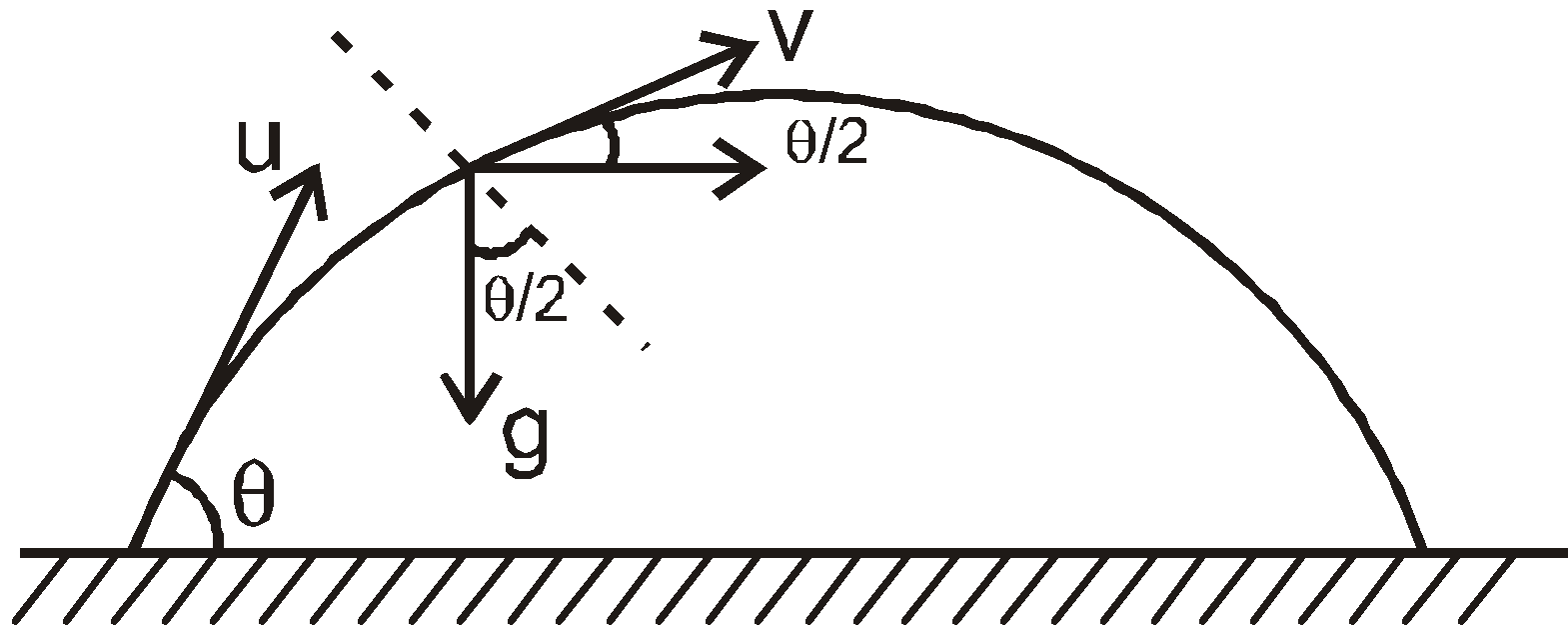
A particle is projected with initial speed u and at an angle
with horizontal. What is the radius of curvature of the parabola traced out by the projectile at a point where the particle velocity makes an angle
/2 with the horizontal?
Text Solution
Verified by ExpertsThe correct answer is:
A
Step 1: The radius of curvature \( R \) of a projectile's path can be derived using the formula: \[ R = \frac{(1 + (\frac{dy}{dx})^2)^{3/2}}{|\frac{d^2y}{dx^2}|} \]
Step 2: The projectile motion equations for horizontal and vertical components are:
\( x(t) = ut \cos(\theta) \) and \( y(t) = ut \sin(\theta) - \frac{1}{2}gt^2 \).
Step 3: Differentiating \( y \) with respect to \( x \):
\[ \frac{dy}{dx} = \frac{\frac{dy}{dt}}{\frac{dx}{dt}} = \frac{u \sin(\theta) - gt}{u \cos(\theta)} \]
Step 4: At the point where the velocity makes an angle \( \frac{\theta}{2} \) with the horizontal, we can substitute \( \theta \) into our previous calculations, yielding a specific value for \( \frac{dy}{dx} \).
Step 5: The second derivative \( \frac{d^2y}{dx^2} \) can then be computed to find the radius of curvature using the angle relationships.
After computation and simplifications, the radius of curvature at the specified angle will result in a value dependent on the specific parameters of the initial speed and angle.
The final answer can be given as a function of \( u \), \( g \), and \( \theta \).
Therefore, option A is the correct answer.
Step 2: The projectile motion equations for horizontal and vertical components are:
\( x(t) = ut \cos(\theta) \) and \( y(t) = ut \sin(\theta) - \frac{1}{2}gt^2 \).
Step 3: Differentiating \( y \) with respect to \( x \):
\[ \frac{dy}{dx} = \frac{\frac{dy}{dt}}{\frac{dx}{dt}} = \frac{u \sin(\theta) - gt}{u \cos(\theta)} \]
Step 4: At the point where the velocity makes an angle \( \frac{\theta}{2} \) with the horizontal, we can substitute \( \theta \) into our previous calculations, yielding a specific value for \( \frac{dy}{dx} \).
Step 5: The second derivative \( \frac{d^2y}{dx^2} \) can then be computed to find the radius of curvature using the angle relationships.
After computation and simplifications, the radius of curvature at the specified angle will result in a value dependent on the specific parameters of the initial speed and angle.
The final answer can be given as a function of \( u \), \( g \), and \( \theta \).
Therefore, option A is the correct answer.
Prepare Smarter with CGP Edu
Get practice questions, solutions, and test series in one place.
Write a Review
Share your experience with this question and solution.
Commentary
Send your comment, doubt, correction, or feedback to admin.
Similar Questions
Explore conceptually related problems
A ball is projected with initial speed u and making an angle with the vertical. Consider a small p…
A particle of mass m begins to slide down a fixed smooth sphere from the top with
negligible initia…
A stone of mass 1 kg tied to a light inextensible string of length , whirling
in a circular path i…
A sphere of mass is suspended by a thread of length ' ' is oscillating in a vertical
plane, the a…
The figure shows the velocity and acceleration of a point like body at the initial moment of
its mo…
A small body of mass m = 0.5 kg is allowed to slide on an inclined frictionless track from rest pos…