Published by:
CGP EDU Academic Team
Published on: September 12, 2026
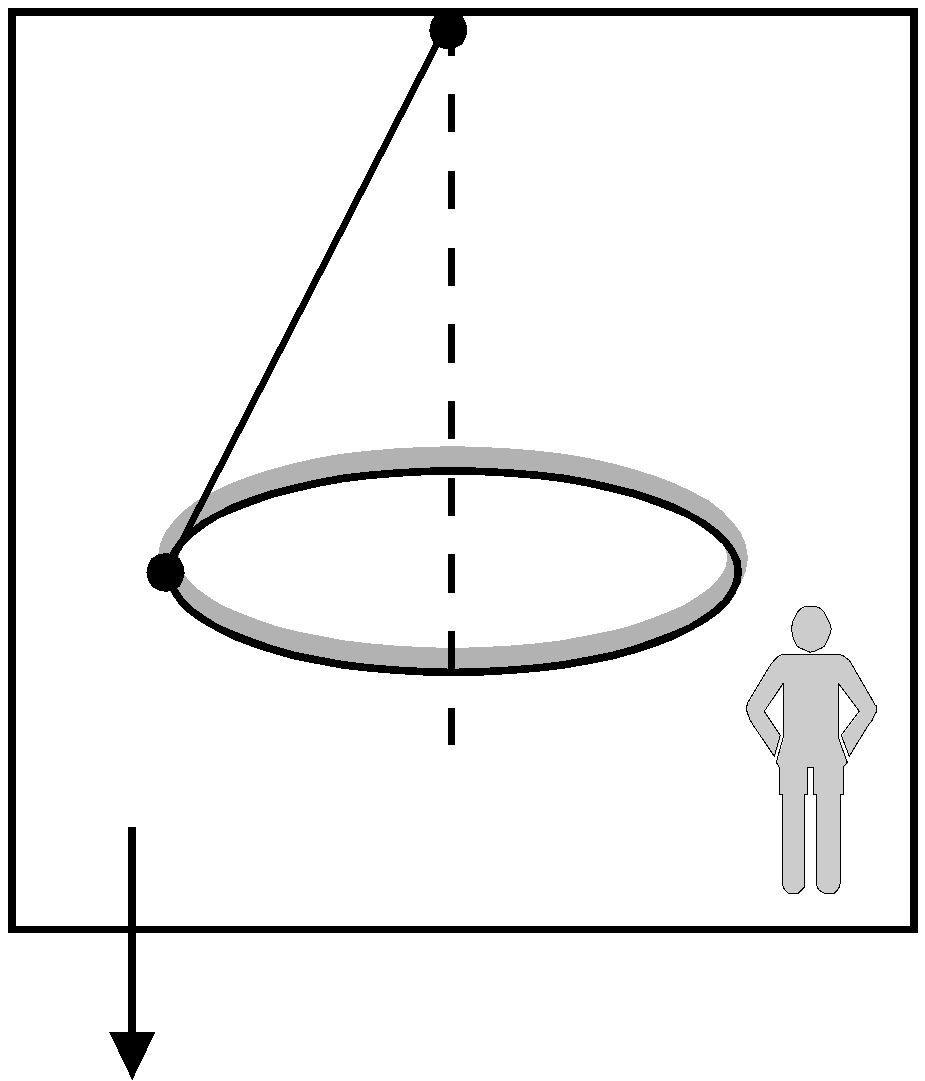
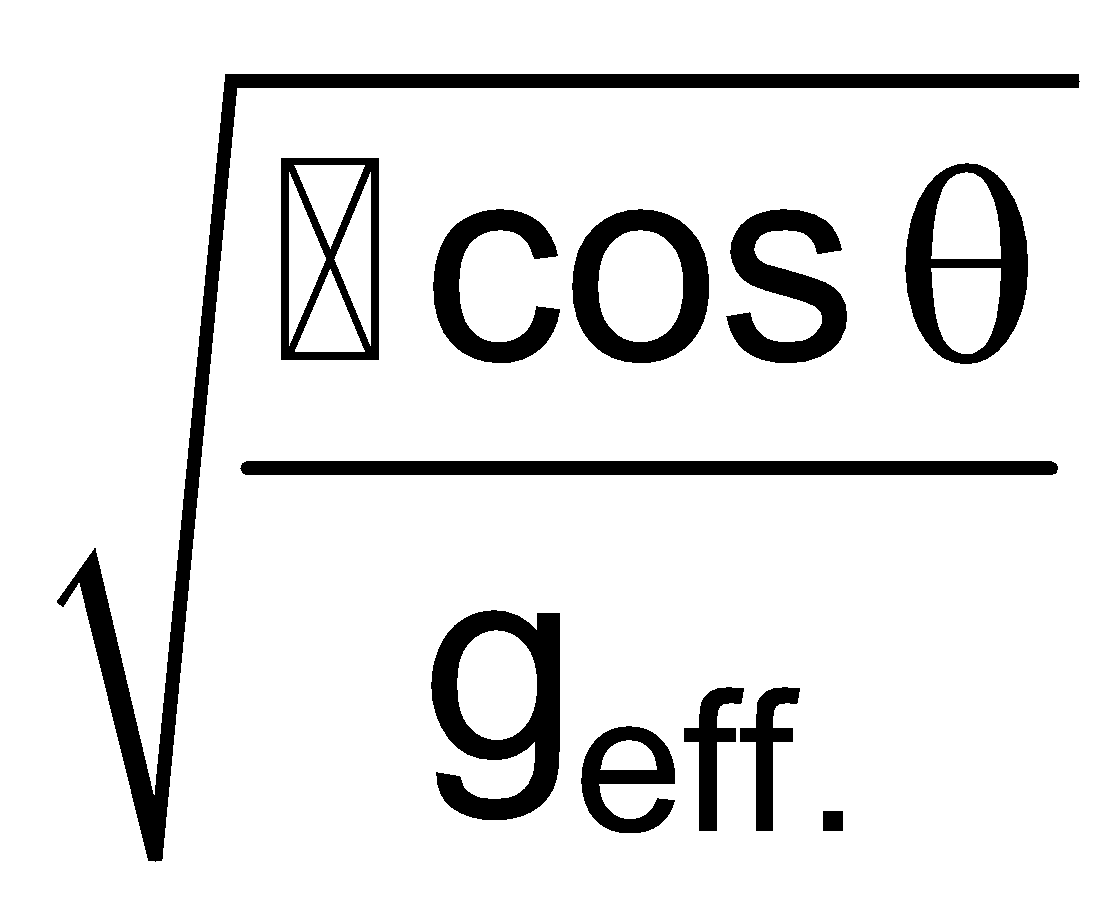
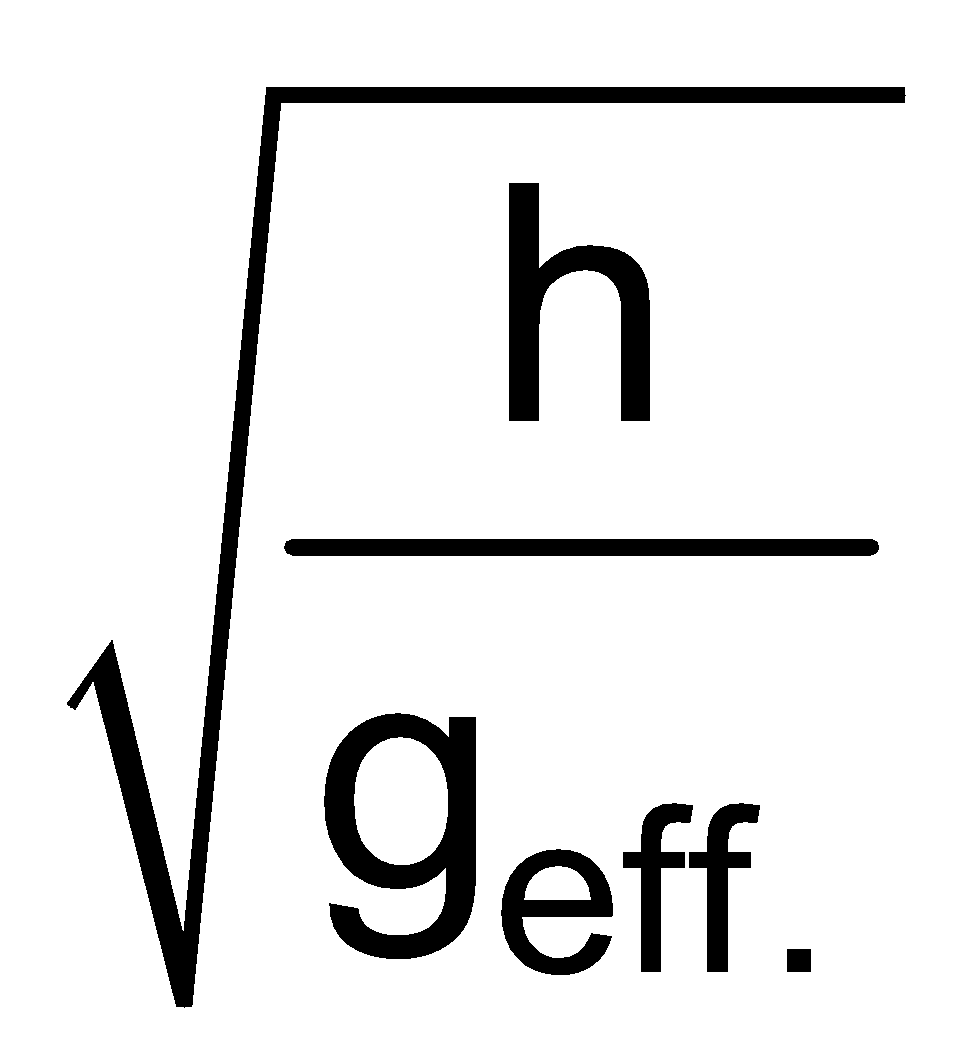
In the figure shown a lift goes downwards with a constant retardation. An observer in the lift observers a conical pendulum in the lift, revolving in a horizontal circle with time period 2 seconds. The distance between the center of the circle and the point of suspension is 2.0 m. Find the retardation of the lift in m/s 2 .
Use
2 = 10 and g = 10 m/s 2

Text Solution
Verified by ExpertsThe correct answer is:
A
Step 1: Identify the parameters.
The given parameters are:
- Time period (T) = 2 s
- Distance (L) = 2.0 m
- Acceleration due to gravity (g) = 10 m/s2
Step 2: Calculate the angular velocity.
The angular velocity (ω) is given by the formula:
$$ ext{ω} = \frac{2\pi}{T}$$
Substituting the values,
$$\text{ω} = \frac{2\pi}{2} = \pi ext{ rad/s}$$
Step 3: Determine the radius of the circular motion.
The height (h) of the pendulum can be calculated using:
$$h = L\sin(\theta)$$
The horizontal component (r) of the motion is:
$$r = L\cos(\theta)$$
Using the right triangle relationship and the time period relations, we know that:
$$g/L = \frac{\omega^2}{L} \implies \text{tan}(\theta) = \frac{L}{h}$$
Hence,
$$h = \frac{g}{\omega^2} = \frac{10}{\pi^2}$$
Given h = 2.0 m, we can calculate the retardation (a).
Step 4: Relate the forces.
The effective force experienced is the combination of g and a (the retardation of lift):
We set up the equation as follows:
$$g - a = \frac{L\omega^2}{L}$$
Substituting the values,
$$10 - a = 2\pi^2$$
Solving for a,
$$a = 10 - 2\pi^2$$
Substituting $$\pi^2 \approx 9.87$$, we get
$$a \approx 10 - 19.74 = -9.74 ext{ m/s}^2$$
Since it’s retardation, we take the positive value.
Step 5: Finalize the answer.
Therefore, the retardation of the lift is approximately $9.74 ext{ m/s}^2$.
Hence, the final answer is A.
The given parameters are:
- Time period (T) = 2 s
- Distance (L) = 2.0 m
- Acceleration due to gravity (g) = 10 m/s2
Step 2: Calculate the angular velocity.
The angular velocity (ω) is given by the formula:
$$ ext{ω} = \frac{2\pi}{T}$$
Substituting the values,
$$\text{ω} = \frac{2\pi}{2} = \pi ext{ rad/s}$$
Step 3: Determine the radius of the circular motion.
The height (h) of the pendulum can be calculated using:
$$h = L\sin(\theta)$$
The horizontal component (r) of the motion is:
$$r = L\cos(\theta)$$
Using the right triangle relationship and the time period relations, we know that:
$$g/L = \frac{\omega^2}{L} \implies \text{tan}(\theta) = \frac{L}{h}$$
Hence,
$$h = \frac{g}{\omega^2} = \frac{10}{\pi^2}$$
Given h = 2.0 m, we can calculate the retardation (a).
Step 4: Relate the forces.
The effective force experienced is the combination of g and a (the retardation of lift):
We set up the equation as follows:
$$g - a = \frac{L\omega^2}{L}$$
Substituting the values,
$$10 - a = 2\pi^2$$
Solving for a,
$$a = 10 - 2\pi^2$$
Substituting $$\pi^2 \approx 9.87$$, we get
$$a \approx 10 - 19.74 = -9.74 ext{ m/s}^2$$
Since it’s retardation, we take the positive value.
Step 5: Finalize the answer.
Therefore, the retardation of the lift is approximately $9.74 ext{ m/s}^2$.
Hence, the final answer is A.
Prepare Smarter with CGP Edu
Get practice questions, solutions, and test series in one place.
Write a Review
Share your experience with this question and solution.
Commentary
Send your comment, doubt, correction, or feedback to admin.
Similar Questions
Explore conceptually related problems
When the road is dry and coefficient of friction is µ, the maximum speed of a car in a circular pat…
Find the maximum speed at which a car can turn round a curve of 30 m radius on a level road if the …
A train has to negotiate a curve of radius 400 m. By how much height should the outer rail be raise…
A road surrounds a circular playing field having radius of 10 m. If a vehicle goes around it at an …
A circular road of radius 1000 m has banking angle 45°. Find the maximum safe speed of a car having…
A turn of radius 20 m is banked for the vehicles going at a speed of 36 km/h. If the coefficient of…