Published by:
CGP EDU Academic Team
Published on: September 12, 2026
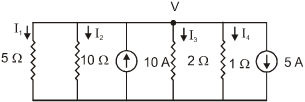
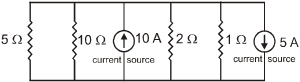
For the circuit shown in figure, find the voltage across 10 Ω Ω resistor and the current passing through it.
Text Solution
Verified by ExpertsThe correct answer is:
D
Step 1: Identify the circuit configuration
We have two branches of resistors and current sources. The left branch has a 5 Ω resistor and a 10 Ω resistor in series, while the right branch has a 1 Ω and a 2 Ω resistor in series with the 5 A current source.
Step 2: Analyze the left branch
The total resistance of the left branch:
R_left = 5 Ω + 10 Ω = 15 Ω.
In this branch, the current from the current source is 10 A. The voltage across the 10 Ω resistor can be calculated using Ohm's Law:
V_{10Ω} = I imes R = 10 A imes 10 Ω = 100 V.
Step 3: Analyze the right branch
The total resistance of the right branch:
R_right = 1 Ω + 2 Ω = 3 Ω.
The current through the right branch (with the 5 A source) is 5 A. The voltage drop across the 2 Ω resistor:
V_{2Ω} = I imes R = 5 A imes 2 Ω = 10 V.
Step 4: Determine the total voltage across the parallel branches
In parallel circuits, the voltage across each branch is equal. Therefore, since we found the voltage across the left branch with the 10 Ω resistor to be 100 V, we conclude that:
V_{across 10Ω} = 100 V.
Step 5: Calculate the current passing through the 10 Ω resistor
The current through the 10 Ω resistor is equal to the current from the source, which is 10 A.
Final result:
Voltage across the 10 Ω resistor is 100 V and the current passing through it is 10 A.
We have two branches of resistors and current sources. The left branch has a 5 Ω resistor and a 10 Ω resistor in series, while the right branch has a 1 Ω and a 2 Ω resistor in series with the 5 A current source.
Step 2: Analyze the left branch
The total resistance of the left branch:
R_left = 5 Ω + 10 Ω = 15 Ω.
In this branch, the current from the current source is 10 A. The voltage across the 10 Ω resistor can be calculated using Ohm's Law:
V_{10Ω} = I imes R = 10 A imes 10 Ω = 100 V.
Step 3: Analyze the right branch
The total resistance of the right branch:
R_right = 1 Ω + 2 Ω = 3 Ω.
The current through the right branch (with the 5 A source) is 5 A. The voltage drop across the 2 Ω resistor:
V_{2Ω} = I imes R = 5 A imes 2 Ω = 10 V.
Step 4: Determine the total voltage across the parallel branches
In parallel circuits, the voltage across each branch is equal. Therefore, since we found the voltage across the left branch with the 10 Ω resistor to be 100 V, we conclude that:
V_{across 10Ω} = 100 V.
Step 5: Calculate the current passing through the 10 Ω resistor
The current through the 10 Ω resistor is equal to the current from the source, which is 10 A.
Final result:
Voltage across the 10 Ω resistor is 100 V and the current passing through it is 10 A.
Prepare Smarter with CGP Edu
Get practice questions, solutions, and test series in one place.
Write a Review
Share your experience with this question and solution.
Commentary
Send your comment, doubt, correction, or feedback to admin.
Similar Questions
Explore conceptually related problems
Specific resistance of a wire depends on its
There are two wires of the same length and of the same material and radii r and 2r. The ratio of th…
If the length and cross-section of a wire is doubled, then the resistance will
V-i graph for an ohmic resistance i
When a resistance wire is passed through a die the cross–section area decreases by 1%, the change i…
When the resistance of copper wire is 0.1 Ω Ω and the radius is 1 mm, then the length of the wire i…