Two (non-physics) students, A and B living in neighboring hostel rooms, decided to economies by connecting their bulbs in series. They agreed that each would install a 100 W bulb in their own rooms and that they would pay equal shares of the electricity bill. However, both decided to try to get better lighting at the other ’ s expense; A installed a 200 W bulb and B installed a 50 W bulb. Which student is more likely to fail the end-of-term examinations?
Text Solution
Verified by ExpertsCHECK THE SOLUTION.
P A = 8 W & P B = 32 W, A is more likely to fail his examinations
Sol. For quantitative purposes we assume that the resistances of the bulbs do not depend upon the voltages across them. This is far from accurate, but will give the correct qualitative conclusion. If the (r.m.s.) supply voltage is V, the resistance r i of a bulb is V 2 /w i , where w i is the nominal rating of the bulb. When the two bulbs are connected in series across the supply, the (r.m.s) current drawn is V/(r A + r B ) and the power dissipated in bulb i (i = A or B ) is
P i = 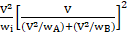
According to the original agreement (w A = w B = 100 W), both P A and P B should be 25 W. Actually, P A = 8 W and P B = 32 W, and so A clearly failed his examinations. By comparison, student B might be considered a double winner: he gets 32 W, but pays for only (8 + 32)/ 2 = 20 W. On the other hand, 32 W is still a very poor light to study by and B also could well have failed his examinations.
Prepare Smarter with CGP Edu
Get practice questions, solutions, and test series in one place.
Write a Review
Share your experience with this question and solution.
Commentary
Send your comment, doubt, correction, or feedback to admin.
Similar Questions
Explore conceptually related problems