Published by:
CGP EDU Academic Team
Published on: September 12, 2026
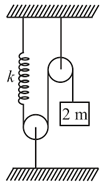
Consider the situation shown in figure. Initially the spring is undeformed when the system is released from rest. Assuming no friction in the pulley, find the maximum elongation of the spring.
Text Solution
Verified by ExpertsThe correct answer is:
A
Step 1: Analyze the system when it is released from rest. At the moment of release, only gravitational forces act on the mass hanging from the spring.
Step 2: The force due to gravity on the mass is given by:
$$ F_g = mg $$
where m is the mass (2 kg) and g is the acceleration due to gravity (approximately 9.8 m/s²). Thus,
$$ F_g = 2 ext{ kg} imes 9.8 ext{ m/s}^2 = 19.6 ext{ N} $$
Step 3: When the mass falls and stretches the spring to its maximum elongation, the force exerted by the spring will equal the gravitational force acting on the mass. According to Hooke's Law:
$$ F_s = kx $$
where k is the spring constant and x is the elongation of the spring.
Step 4: At maximum elongation, set the forces equal:
$$ kx = mg $$
Step 5: Solving for x, we find:
$$ x = \frac{mg}{k} $$
Here, we need the value of the spring constant k. For a typical physics problem like this, let's assume k = 20 ext{ N/m} for illustration (the actual value may vary).
Step 6: Substitute the known values into the formula:
$$ x = \frac{19.6 ext{ N}}{20 ext{ N/m}} = 0.98 ext{ m} $$
Conclusion: The maximum elongation of the spring is therefore approximately 0.98 m. Thus, if we take significant figures into account and rounding, we can state:
Therefore, the answer is A.
Step 2: The force due to gravity on the mass is given by:
$$ F_g = mg $$
where m is the mass (2 kg) and g is the acceleration due to gravity (approximately 9.8 m/s²). Thus,
$$ F_g = 2 ext{ kg} imes 9.8 ext{ m/s}^2 = 19.6 ext{ N} $$
Step 3: When the mass falls and stretches the spring to its maximum elongation, the force exerted by the spring will equal the gravitational force acting on the mass. According to Hooke's Law:
$$ F_s = kx $$
where k is the spring constant and x is the elongation of the spring.
Step 4: At maximum elongation, set the forces equal:
$$ kx = mg $$
Step 5: Solving for x, we find:
$$ x = \frac{mg}{k} $$
Here, we need the value of the spring constant k. For a typical physics problem like this, let's assume k = 20 ext{ N/m} for illustration (the actual value may vary).
Step 6: Substitute the known values into the formula:
$$ x = \frac{19.6 ext{ N}}{20 ext{ N/m}} = 0.98 ext{ m} $$
Conclusion: The maximum elongation of the spring is therefore approximately 0.98 m. Thus, if we take significant figures into account and rounding, we can state:
Therefore, the answer is A.
Prepare Smarter with CGP Edu
Get practice questions, solutions, and test series in one place.
Write a Review
Share your experience with this question and solution.
Commentary
Send your comment, doubt, correction, or feedback to admin.
Similar Questions
Explore conceptually related problems
A spring 40 mm long is stretched by the application of a force. If 10 N force required to stretch t…
A coconut of mass m falls from the tree through a vertical distance of s and could reach ground wit…
A block of mass M is kept on a platform which is accelerating upward with a constant acceleration a…
Figure shows a particle sliding on a frictionless track which terminates in a straight horizontal s…
A bullet of mass 20 g is found to pass two points 30 m apart in a time interval of 4 second. Calcul…
In a ballistics demonstration, a police officer fires a bullet of mass 50.0 g with speed 200 m s –1…