Published by:
CGP EDU Academic Team
Published on: September 12, 2026
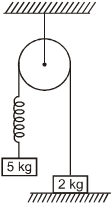
The system as shown in the figure is released from rest. The pulley, spring and string are ideal & friction is absent everywhere. If speed of 5 kg block when 2 kg block leaves the contact with ground is

m/s, then value of x is: (spring constant k = 40 N/m & g = 10 m/s 2 )
Text Solution
Verified by ExpertsThe correct answer is:
A
Given:
Mass of block A, m_A = 5 kg
Mass of block B, m_B = 2 kg
Speed of mass A when B leaves contact, v = 5 m/s
Spring constant, k = 40 N/m
Gravitational acceleration, g = 10 m/s²
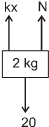
When block B leaves the ground, it can be considered that the motion of block A is also an increase in spring potential energy.
The gravitational potential energy lost by block B plus the kinetic energy gained by block A will equal the elastic potential energy stored in the spring.
1. Calculate the gravitational potential energy lost by block B as it descends by distance x: \[ PE_B = m_B imes g imes x \]
2. The kinetic energy gained by block A is given by: \[ KE_A = \frac{1}{2} m_A v^2 \]
3. The elastic potential energy stored in the spring is: \[ PE_{spring} = \frac{1}{2} k x^2 \]
Using conservation of energy, we can equate the energies:
\[ m_B g x + \frac{1}{2} m_A v^2 = \frac{1}{2} k x^2 \]
Substitute the values:
\[ 2 kg \times 10 m/s² \times x + \frac{1}{2} \times 5 kg \times (5 m/s)^2 = \frac{1}{2} \times 40 N/m \times x^2 \]
\[ 20x + \frac{1}{2} \times 5 \times 25 = 20x^2 \]
\[ 20x + 62.5 = 20x^2 \]
Rearranging gives: \[ 20x^2 - 20x - 62.5 = 0 \]
Dividing by 5 leads to: \[ 4x^2 - 4x - 12.5 = 0 \]
Solving using the quadratic formula: \[ x = \frac{-(-4) \pm \sqrt{(-4)^2 - 4 \cdot 4 \cdot (-12.5)}}{2 \cdot 4} \]
\[ x = \frac{4 \pm \sqrt{16 + 200}}{8} \]
\[ x = \frac{4 \pm 14}{8} \]
Taking the positive root: \[ x = \frac{18}{8} = 2.25 \text{ m} \]
Therefore, the value of x is 2.25 m.
Mass of block A, m_A = 5 kg
Mass of block B, m_B = 2 kg
Speed of mass A when B leaves contact, v = 5 m/s
Spring constant, k = 40 N/m
Gravitational acceleration, g = 10 m/s²
When block B leaves the ground, it can be considered that the motion of block A is also an increase in spring potential energy.
The gravitational potential energy lost by block B plus the kinetic energy gained by block A will equal the elastic potential energy stored in the spring.
1. Calculate the gravitational potential energy lost by block B as it descends by distance x: \[ PE_B = m_B imes g imes x \]
2. The kinetic energy gained by block A is given by: \[ KE_A = \frac{1}{2} m_A v^2 \]
3. The elastic potential energy stored in the spring is: \[ PE_{spring} = \frac{1}{2} k x^2 \]
Using conservation of energy, we can equate the energies:
\[ m_B g x + \frac{1}{2} m_A v^2 = \frac{1}{2} k x^2 \]
Substitute the values:
\[ 2 kg \times 10 m/s² \times x + \frac{1}{2} \times 5 kg \times (5 m/s)^2 = \frac{1}{2} \times 40 N/m \times x^2 \]
\[ 20x + \frac{1}{2} \times 5 \times 25 = 20x^2 \]
\[ 20x + 62.5 = 20x^2 \]
Rearranging gives: \[ 20x^2 - 20x - 62.5 = 0 \]
Dividing by 5 leads to: \[ 4x^2 - 4x - 12.5 = 0 \]
Solving using the quadratic formula: \[ x = \frac{-(-4) \pm \sqrt{(-4)^2 - 4 \cdot 4 \cdot (-12.5)}}{2 \cdot 4} \]
\[ x = \frac{4 \pm \sqrt{16 + 200}}{8} \]
\[ x = \frac{4 \pm 14}{8} \]
Taking the positive root: \[ x = \frac{18}{8} = 2.25 \text{ m} \]
Therefore, the value of x is 2.25 m.
Prepare Smarter with CGP Edu
Get practice questions, solutions, and test series in one place.
Write a Review
Share your experience with this question and solution.
Commentary
Send your comment, doubt, correction, or feedback to admin.
Similar Questions
Explore conceptually related problems
A spring 40 mm long is stretched by the application of a force. If 10 N force required to stretch t…
A coconut of mass m falls from the tree through a vertical distance of s and could reach ground wit…
A block of mass M is kept on a platform which is accelerating upward with a constant acceleration a…
Figure shows a particle sliding on a frictionless track which terminates in a straight horizontal s…
A bullet of mass 20 g is found to pass two points 30 m apart in a time interval of 4 second. Calcul…
In a ballistics demonstration, a police officer fires a bullet of mass 50.0 g with speed 200 m s –1…