Published by:
CGP EDU Academic Team
Published on: September 12, 2026
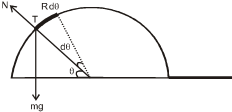
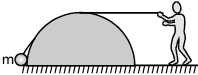
As shown in the figure a person is pulling a mass ' m ‘from ground on a fixed rough hemispherical surface upto the top of the hemisphere with the help of a light inextensible string. Find the work done (in Joules) by tension in the string on mass m if radius of hemisphere is R and friction coefficient is µ. Assume that the block is pulled with negligible velocity (take µ = 0.1, m = 1kg, g = 10m/s 2 , R = 1m).
Text Solution
Verified by ExpertsThe correct answer is:
A
Step 1: Analyze the Forces
When the person pulls the mass 'm' from the ground to the top of the hemisphere, we need to consider two primary forces acting on the mass 'm':
Since the coefficient of friction ($\mu$) is 0.1, the frictional force can be calculated as $F_f = 0.1 \times 10 ext{ N} = 1 ext{ N}$.
Step 2: Calculate the Distance
The distance d that the mass 'm' moves can be visualized as the height of the hemisphere, which equals the radius, $R=1 ext{ m}$.
Step 3: Calculate the Work Done
The work done by the tension in the string can be calculated using the equation:
$$ W = F_{tension} \times d $$
Where $F_{tension}$ compensates for the work done against gravitational force and friction:
$$ F_{tension} = F_g + F_f = 10 ext{ N} + 1 ext{ N} = 11 ext{ N} $$
The work done by the tension is:
$$ W = 11 ext{ N} \times 1 ext{ m} = 11 ext{ J} $$
Therefore, the work done by the tension in the string on the mass 'm' is 11 Joules.
When the person pulls the mass 'm' from the ground to the top of the hemisphere, we need to consider two primary forces acting on the mass 'm':
- The gravitational force: $F_g = mg = 1 ext{ kg} \times 10 ext{ m/s}^2 = 10 ext{ N}$.
- The frictional force due to the rough surface: $F_f = \mu N$, where $N$ is the normal force. Here, $N = mg$ at the bottom (horizontal surface) due to the vertical pull.
Since the coefficient of friction ($\mu$) is 0.1, the frictional force can be calculated as $F_f = 0.1 \times 10 ext{ N} = 1 ext{ N}$.
Step 2: Calculate the Distance
The distance d that the mass 'm' moves can be visualized as the height of the hemisphere, which equals the radius, $R=1 ext{ m}$.
Step 3: Calculate the Work Done
The work done by the tension in the string can be calculated using the equation:
$$ W = F_{tension} \times d $$
Where $F_{tension}$ compensates for the work done against gravitational force and friction:
$$ F_{tension} = F_g + F_f = 10 ext{ N} + 1 ext{ N} = 11 ext{ N} $$
The work done by the tension is:
$$ W = 11 ext{ N} \times 1 ext{ m} = 11 ext{ J} $$
Therefore, the work done by the tension in the string on the mass 'm' is 11 Joules.
Prepare Smarter with CGP Edu
Get practice questions, solutions, and test series in one place.
Write a Review
Share your experience with this question and solution.
Commentary
Send your comment, doubt, correction, or feedback to admin.
Similar Questions
Explore conceptually related problems
A spring 40 mm long is stretched by the application of a force. If 10 N force required to stretch t…
A coconut of mass m falls from the tree through a vertical distance of s and could reach ground wit…
A block of mass M is kept on a platform which is accelerating upward with a constant acceleration a…
Figure shows a particle sliding on a frictionless track which terminates in a straight horizontal s…
A bullet of mass 20 g is found to pass two points 30 m apart in a time interval of 4 second. Calcul…
In a ballistics demonstration, a police officer fires a bullet of mass 50.0 g with speed 200 m s –1…