Published by:
CGP EDU Academic Team
Published on: September 12, 2026
In the fig. the potentiometer wire AB of length L & resistance 9 r is joined to the cell D of e.m.f. ε & internal resistance r. The cell C's e.m.f. is ε /2 and its internal resistance is 2 r. The galvanometer G will show no deflection then find length AJ:
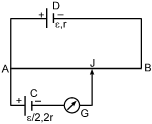
Text Solution
Verified by ExpertsThe correct answer is:
A
To find the length AJ such that the galvanometer shows no deflection, we will first set the potential differences across the potentiometer wire and the cell C equal to each other as they balance each other.
1. **Given Information**:
- E.M.F. of cell D = ε
- Internal resistance of cell D = r
- E.M.F. of cell C = ε/2
- Internal resistance of cell C = 2r
- Resistance of potentiometer wire AB = 9r
- Total length of potentiometer wire = L
2. **Potential Difference Across Potentiometer Wire**:
The potential difference across the potentiometer wire of length AJ is given by:
\[ V = I \times R = I \times \frac{9r \cdot AJ}{L} \] Where I is the current through the potentiometer wire, \( AJ = \text{length between point A and J} \).
3. **Total Current Through Cell D**:
The total current supplied by cell D is given by:
\[ I = \frac{E_{cell}}{R + r} = \frac{\epsilon}{9r + r} = \frac{\epsilon}{10r} \]
4. **Potential Drop Across Potentiometer Wire**:
Therefore, the potential drop in length AJ is:
\[ V_{AJ} = I \times \frac{9r \cdot AJ}{L} = \frac{\epsilon}{10r} \times \frac{9r \cdot AJ}{L} = \frac{9\epsilon\,AJ}{10L} \]
5. **Potential Drop Across Cell C**:
The potential drop across C is given by:
\[ V_C = I_C imes R_C = \frac{\epsilon/2}{2r} = \frac{\epsilon}{4r} \]
6. **Setting Equal for No Deflection**:
We set these two equations equal for the state of no deflection:
\[ \frac{9\epsilon AJ}{10L} = \frac{\epsilon}{4r} \]
7. **Solving for AJ**:
Cancel ε from both sides:
\[ \frac{9AJ}{10L} = \frac{1}{4} \]
Rearranging gives:
\[ AJ = \frac{10L}{9} \cdot \frac{1}{4} = \frac{10L}{36} = \frac{5L}{18} \]
Therefore, the length AJ is \( \frac{5L}{18} \).
Hence, we have found the length AJ where the galvanometer shows no deflection.
1. **Given Information**:
- E.M.F. of cell D = ε
- Internal resistance of cell D = r
- E.M.F. of cell C = ε/2
- Internal resistance of cell C = 2r
- Resistance of potentiometer wire AB = 9r
- Total length of potentiometer wire = L
2. **Potential Difference Across Potentiometer Wire**:
The potential difference across the potentiometer wire of length AJ is given by:
\[ V = I \times R = I \times \frac{9r \cdot AJ}{L} \] Where I is the current through the potentiometer wire, \( AJ = \text{length between point A and J} \).
3. **Total Current Through Cell D**:
The total current supplied by cell D is given by:
\[ I = \frac{E_{cell}}{R + r} = \frac{\epsilon}{9r + r} = \frac{\epsilon}{10r} \]
4. **Potential Drop Across Potentiometer Wire**:
Therefore, the potential drop in length AJ is:
\[ V_{AJ} = I \times \frac{9r \cdot AJ}{L} = \frac{\epsilon}{10r} \times \frac{9r \cdot AJ}{L} = \frac{9\epsilon\,AJ}{10L} \]
5. **Potential Drop Across Cell C**:
The potential drop across C is given by:
\[ V_C = I_C imes R_C = \frac{\epsilon/2}{2r} = \frac{\epsilon}{4r} \]
6. **Setting Equal for No Deflection**:
We set these two equations equal for the state of no deflection:
\[ \frac{9\epsilon AJ}{10L} = \frac{\epsilon}{4r} \]
7. **Solving for AJ**:
Cancel ε from both sides:
\[ \frac{9AJ}{10L} = \frac{1}{4} \]
Rearranging gives:
\[ AJ = \frac{10L}{9} \cdot \frac{1}{4} = \frac{10L}{36} = \frac{5L}{18} \]
Therefore, the length AJ is \( \frac{5L}{18} \).
Hence, we have found the length AJ where the galvanometer shows no deflection.
Prepare Smarter with CGP Edu
Get practice questions, solutions, and test series in one place.
Write a Review
Share your experience with this question and solution.
Commentary
Send your comment, doubt, correction, or feedback to admin.
Similar Questions
Explore conceptually related problems
The current through the ammeter shown in figure is 1 A. If each of the 4 Ω Ω resistor is replaced b…
The meter-bridge wire AB shown in figure is 50 cm long. When AD = 30 cm, no deflection occurs in th…
The potential gradient of a potentiometer wire is defined as
The unit of potential gradient is
The length of the potentiometer wire is kept larger so that the value of potential gradient may
For the same potential difference, a potentiometer wire is replaced by another one of a high specif…