Match the List-I with List-II.
List-I | List-II | ||||||||||
A. | Wurtz reaction | (i) |
| Electrophilic addition | reaction | ||||||
Electrophilic addition | |||||||||||
reaction | |||||||||||
B. |
| Hydration of | alkenes | (ii) |
| Nucleophilic | substitution reaction | ||||
Hydration of | |||||||||||
alkenes | |||||||||||
Nucleophilic | |||||||||||
substitution reaction | |||||||||||
C. | Nitration of alkanes | (iii) |
| Free radical | substitution | ||||||
Free radical | |||||||||||
substitution | |||||||||||
D. |
| Reaction of alkene | with NBS | (iv) |
| Electrophilic | substitution reaction | ||||
Reaction of alkene | |||||||||||
with NBS | |||||||||||
Electrophilic | |||||||||||
substitution reaction |
Choose the correct answer from the options given below.
Text Solution
Verified by ExpertsC
Wurtz reaction is a nucleophillic substitution reaction as it involves exchange of halogen and metal with the involvement of radical species  to form
  bond.
bond.

Hydration of alkene involves act of adding electrophillic hydrogen on nucleophillic alkenes. So, it is a electrophillic addition reaction.
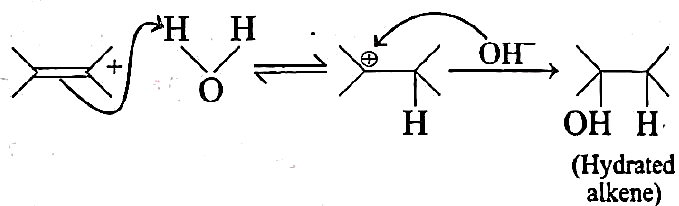
Nitration of alkane involves substitution of  from alkene by a nitro group (electrophile). So, it is a electrophillic substitution reaction.
Reaction of alkene with NBS involves formation of free radical  from NBS reagent and hydrogen atom at allylic position will get substitution by bromine radical. So, it is a type of free radical substitution reaction.
Hence, the correct match is A-(ii), B-(i), C-(iv), D-(iii).
Prepare Smarter with CGP Edu
Get practice questions, solutions, and test series in one place.
Write a Review
Share your experience with this question and solution.
Commentary
Send your comment, doubt, correction, or feedback to admin.
Similar Questions
Explore conceptually related problems