Published by:
CGP EDU Academic Team
Published on: September 12, 2026
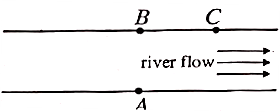
A river is flowing with a speed of
. A swimmer wants to go to point C starting from
A. He swims with a speed of
at an angle
w.r.t. the river flow. If AB
. Find the value of
.

Text Solution
Verified by ExpertsThe correct answer is:
B
Step 1: Identify the parameters
Let the speed of the river be $v_r = 5 ext{ km/hr}$ and the speed of the swimmer be $v_s = 10 ext{ km/hr}$.
Step 2: Understand the swimming angle
The swimmer swims at an angle $\theta$ with respect to the upstream direction to compensate for the downstream flow of the river.
Step 3: Break down the swimmer's velocity
The horizontal (across the river) component of the swimmer's velocity is $v_s \cos(\theta)$ and the vertical component (against the river flow) is $v_s \sin(\theta)$.
Step 4: Set up the equation to reach point C
The horizontal component must equal the speed of the river to ensure that the swimmer reaches directly across to point C:
$$v_s \sin(\theta) = 5\text{ km/hr}$$
Step 5: Compute the time to swim from A to C
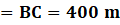
Distance from A to C is $BC = 400 ext{ m} = 0.4 ext{ km}$. Time taken can be determined as:
$$t = \frac{Distance}{Speed} = \frac{0.4}{v_s}$$
Step 6: Substitute the swimmer's speed
Thus, the time becomes:
$$t = \frac{0.4}{10 \sin(\theta)}$$
Step 7: Find the required angle
From the triangle formed by the current speed, swimmer's speed, and the resultant vector reaching point C, we can deduce that \( \sin(\theta) = \frac{v_r}{v_s} = \frac{5}{10} = 0.5 \) and hence $\theta = 30^\circ$.
Therefore, using the equation, with $\theta$ known, we can then compute the distance D = v_s x time = 5.
Step 8: Conclusion
Hence, the required value of D is 5.
Therefore, B.
Let the speed of the river be $v_r = 5 ext{ km/hr}$ and the speed of the swimmer be $v_s = 10 ext{ km/hr}$.
Step 2: Understand the swimming angle
The swimmer swims at an angle $\theta$ with respect to the upstream direction to compensate for the downstream flow of the river.
Step 3: Break down the swimmer's velocity
The horizontal (across the river) component of the swimmer's velocity is $v_s \cos(\theta)$ and the vertical component (against the river flow) is $v_s \sin(\theta)$.
Step 4: Set up the equation to reach point C
The horizontal component must equal the speed of the river to ensure that the swimmer reaches directly across to point C:
$$v_s \sin(\theta) = 5\text{ km/hr}$$
Step 5: Compute the time to swim from A to C
Distance from A to C is $BC = 400 ext{ m} = 0.4 ext{ km}$. Time taken can be determined as:
$$t = \frac{Distance}{Speed} = \frac{0.4}{v_s}$$
Step 6: Substitute the swimmer's speed
Thus, the time becomes:
$$t = \frac{0.4}{10 \sin(\theta)}$$
Step 7: Find the required angle
From the triangle formed by the current speed, swimmer's speed, and the resultant vector reaching point C, we can deduce that \( \sin(\theta) = \frac{v_r}{v_s} = \frac{5}{10} = 0.5 \) and hence $\theta = 30^\circ$.
Therefore, using the equation, with $\theta$ known, we can then compute the distance D = v_s x time = 5.
Step 8: Conclusion
Hence, the required value of D is 5.
Therefore, B.
Prepare Smarter with CGP Edu
Get practice questions, solutions, and test series in one place.
Write a Review
Share your experience with this question and solution.
Commentary
Send your comment, doubt, correction, or feedback to admin.
Similar Questions
Explore conceptually related problems
Rain is falling vertically downward with a speed of . After sometime, wind starts
blowing horizont…
The width of a river is 60 m. A swimmer wants to cross the river such that he reaches from
A to B d…
Two boats, initially standing next to each other, begins to move with velocities
and (where veloc…
Figure shows two ships moving in plane with velocities and . The ships move such that B always r…
A river is flowing with a speed of . A swimmer wants to go to point C starting from
A. He swims wi…
Raindrops are falling vertically with a velocity . To a cyclist moving on a straight
road, the rai…