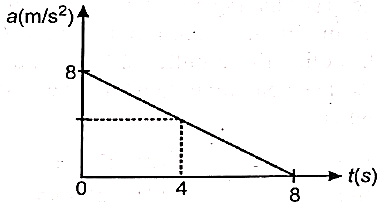
The acceleration-time graph of a particle moving along  -axis is shown in the figure. If the
particle starts with velocity of  at
at  , find the velocity of the particle at
  .
.
A

B

C

D

Text Solution
Verified by ExpertsThe correct answer is:
C
The velocity after 4 s will depend on the change in velocity of the particle in the interval 0 s to
4 s, which is given by the area under  graph. Before calculating the area, let us find the acceleration at
  .
.
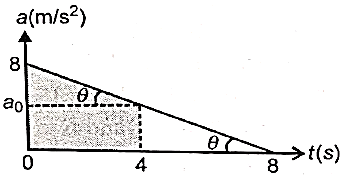

Change in velocity  Area between 0 s to 4 s
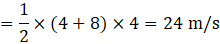
 final velocity
  initial velocity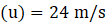

Prepare Smarter with CGP Edu
Get practice questions, solutions, and test series in one place.
Write a Review
Share your experience with this question and solution.
Commentary
Send your comment, doubt, correction, or feedback to admin.
Similar Questions
Explore conceptually related problems
The displacement-time graph for the two particles A and B are straight lines inclined at angles 30 …
The variation of velocity of a particle moving along straight line is shown in figure. The distance…
The adjoining curve represents the velocity-time graph of a particle, its acceleration values along…
The velocity-time graph of a linear motion is shown below. The displacement from the origin after 8…
The following figures show some velocity V versus time t curves. But only some of these can be real…
A rocket is projected vertically upwards and its time velocity graph is shown in the figure. The ma…