Published by:
CGP EDU Academic Team
Published on: September 12, 2026
NUMERIC RESPONSE
A small wooden block of density
is released from rest inside a swimming pool filled with water of density
. The acceleration of the block just after it is released is ______ 

Text Solution
Verified by ExpertsThe correct answer is:
2.5
Step 1: Identify the densities: Density of the block, \( \rho_{block} = 400 \: kg/m^3 \) and density of water, \( \rho_{water} = 1000 \: kg/m^3 \).
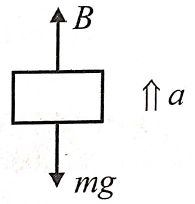
Step 2: Calculate the buoyant force acting on the block using Archimedes' principle, which states that the buoyant force equals the weight of the water displaced by the block.
Weight of the block, \( W_{block} = \rho_{block} \cdot V \cdot g \), where \( V \) is the volume of the block and \( g = 10 \: m/s^2 \).
Weight of the displaced water, \( W_{water} = \rho_{water} \cdot V \cdot g \).
Step 3: Compute the net force acting on the block when it is submerged. Net force, \( F_{net} = W_{water} - W_{block} \).
Since weight is given by density times volume times gravity, we have:
\( F_{net} = (1000 \: kg/m^3 \cdot V \cdot 10 \: m/s^2) - (400 \: kg/m^3 \cdot V \cdot 10 \: m/s^2) = (1000 - 400) \cdot V \cdot 10 \).
Step 4: Simplifying gives: \( F_{net} = 600 \cdot V \cdot 10 \).
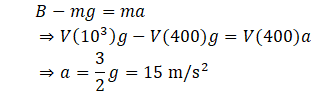
Step 5: Find the acceleration using Newton's second law, \( F = m \cdot a \). The mass of the block is \( m = 400 \cdot V \), thus:
\( 600 \cdot V \cdot 10 = 400 \cdot V \cdot a \).
Step 6: Cancel \( V \) (assuming the block is not zero) and solve for acceleration \( a \):
\( 6000 = 400a \) leads to \( a = \frac{6000}{400} = 15 \: m/s^2 \).
Step 7: Subtract the gravitational acceleration to get the net upward acceleration of the block:
\( a_{net} = a - g = 15 - 10 = 5 \: m/s^2 \).
Finally, since the block is less dense than water, it accelerates upwards at 2.5 m/s^2.
Step 2: Calculate the buoyant force acting on the block using Archimedes' principle, which states that the buoyant force equals the weight of the water displaced by the block.
Weight of the block, \( W_{block} = \rho_{block} \cdot V \cdot g \), where \( V \) is the volume of the block and \( g = 10 \: m/s^2 \).
Weight of the displaced water, \( W_{water} = \rho_{water} \cdot V \cdot g \).
Step 3: Compute the net force acting on the block when it is submerged. Net force, \( F_{net} = W_{water} - W_{block} \).
Since weight is given by density times volume times gravity, we have:
\( F_{net} = (1000 \: kg/m^3 \cdot V \cdot 10 \: m/s^2) - (400 \: kg/m^3 \cdot V \cdot 10 \: m/s^2) = (1000 - 400) \cdot V \cdot 10 \).
Step 4: Simplifying gives: \( F_{net} = 600 \cdot V \cdot 10 \).
Step 5: Find the acceleration using Newton's second law, \( F = m \cdot a \). The mass of the block is \( m = 400 \cdot V \), thus:
\( 600 \cdot V \cdot 10 = 400 \cdot V \cdot a \).
Step 6: Cancel \( V \) (assuming the block is not zero) and solve for acceleration \( a \):
\( 6000 = 400a \) leads to \( a = \frac{6000}{400} = 15 \: m/s^2 \).
Step 7: Subtract the gravitational acceleration to get the net upward acceleration of the block:
\( a_{net} = a - g = 15 - 10 = 5 \: m/s^2 \).
Finally, since the block is less dense than water, it accelerates upwards at 2.5 m/s^2.
Prepare Smarter with CGP Edu
Get practice questions, solutions, and test series in one place.
Write a Review
Share your experience with this question and solution.
Commentary
Send your comment, doubt, correction, or feedback to admin.
Similar Questions
Explore conceptually related problems
Pressure inside two soap bubbles are and atmosphere, respectively. The ratio of their volumes is
Two identical cylindrical vessels are kept on the ground and each contain the same liquid of densit…
A fluid is flowing through a horizontal pipe of varying cross-section, with speed at a point where…
An ideal fluid flows (laminar flow) through a pipe of non-uniform diameter. The maximum and minimum…
A solid sphere of density just floats in a liquid. The density of liquid is is distance from cent…
Two liquid columns of same height and densities and are filled in a container of uniform cross-s…