A particle moving along  -axis has acceleration
  , at time
  , given by
 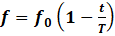 , where
  and
and  are constants. The particle at
  has zero velocity. In the time interval between
  and the instant when
  , the change in particle's velocity
  is
is
A

B

C

D

Text Solution
Verified by ExpertsThe correct answer is:
C
Here, 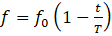 or,
or, 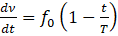 Or,
Or, 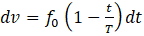
 Or,
Or, 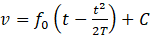
where C is the constant of integration.
At 
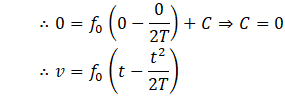
If  , then
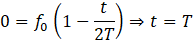
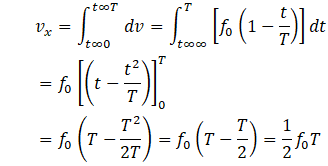
Hence, change in particle's velocity in the time interval  and
and  is given by
Prepare Smarter with CGP Edu
Get practice questions, solutions, and test series in one place.
Write a Review
Share your experience with this question and solution.
Commentary
Send your comment, doubt, correction, or feedback to admin.
Similar Questions
Explore conceptually related problems
PHYSICS
SINGLE CORRECT MCQ.
The position co-ordinates of a particle moving in a space varries with …
The diameter and height of a cylinder are measured by a meter scale to be and , respectively. Wha…
An equilateral triangle is constructed by joining three identical thin uniform rods. Consider two a…
A particle initially at rest moves in a stra1ght line with constant acceleration. The instantaneous…
The resultant magnitude of the three vectors and with their magnitudes mentioned as shown in adjo…
Initially, the system is at rest. Find out maximum value of for which the blocks move together. [T…