Published by:
CGP EDU Academic Team
Published on: September 12, 2026
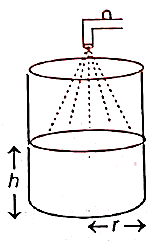
Water pours out at the rate of q from a tap, into a cylindrical vessel of radius r. The rate at which the height of water level rises when the height is h, is …….. .
Text Solution
Verified by ExpertsThe correct answer is:
A
Step 1: Identify the variables involved:
- Let the radius of the cylindrical vessel be r.
- Let the height of the water level be h.
- Let the volume flow rate be q (volume per unit time).
Step 2: The volume of water in the cylindrical vessel can be expressed as:
$$ V = ext{Base Area} imes ext{Height} = \\pi r^2 h $$
Step 3: The rate of change of volume with respect to time is the volume flow rate, which can be expressed as:
$$ rac{dV}{dt} = rac{d}{dt}(\\pi r^2 h) $$
Step 4: Since the base area \\pi r^2 is constant, we can differentiate:
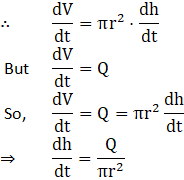
$$ rac{dV}{dt} = \\pi r^2 rac{dh}{dt} $$
Step 5: Setting the two expressions for volume flow rate equal gives us:
$$ q = \\pi r^2 rac{dh}{dt} $$
Step 6: Solving for \\frac{dh}{dt}:
$$ rac{dh}{dt} = \frac{q}{\\pi r^2} $$
Conclusion: The rate at which the height of water level rises when the height is h is given by \\frac{q}{\\pi r^2}. Hence, the answer is: the rate of height rise is directly proportional to the outflow rate and inversely proportional to the area of the base.
- Let the radius of the cylindrical vessel be r.
- Let the height of the water level be h.
- Let the volume flow rate be q (volume per unit time).
Step 2: The volume of water in the cylindrical vessel can be expressed as:
$$ V = ext{Base Area} imes ext{Height} = \\pi r^2 h $$
Step 3: The rate of change of volume with respect to time is the volume flow rate, which can be expressed as:
$$ rac{dV}{dt} = rac{d}{dt}(\\pi r^2 h) $$
Step 4: Since the base area \\pi r^2 is constant, we can differentiate:
$$ rac{dV}{dt} = \\pi r^2 rac{dh}{dt} $$
Step 5: Setting the two expressions for volume flow rate equal gives us:
$$ q = \\pi r^2 rac{dh}{dt} $$
Step 6: Solving for \\frac{dh}{dt}:
$$ rac{dh}{dt} = \frac{q}{\\pi r^2} $$
Conclusion: The rate at which the height of water level rises when the height is h is given by \\frac{q}{\\pi r^2}. Hence, the answer is: the rate of height rise is directly proportional to the outflow rate and inversely proportional to the area of the base.
Prepare Smarter with CGP Edu
Get practice questions, solutions, and test series in one place.
Write a Review
Share your experience with this question and solution.
Commentary
Send your comment, doubt, correction, or feedback to admin.
Similar Questions
Explore conceptually related problems