Published by:
CGP EDU Academic Team
Published on: September 12, 2026
The position of a particle moving along X-axis varies with time
according to equation
, where
is constant. Find the region in which particle is confined.
Text Solution
Verified by ExpertsThe correct answer is:
A
Step 1: The given equation for the position of the particle is \( x = \sqrt{3}\sin(\omega t) - \cos(\omega t) \).
Step 2: To find the range of motion, we can rewrite this as a single sinusoidal function using the amplitude-phase formula.
Step 3: The maximum and minimum values of \( x \) can be determined by recognizing that both sine and cosine functions vary between -1 and 1.
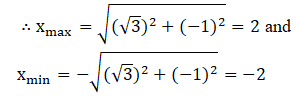
This can be expressed as: \( R = \sqrt{A^2 + B^2} \), where \( A = \sqrt{3} \) and \( B = -1 \). Thus, \( R = \sqrt{(\sqrt{3})^2 + (-1)^2} = \sqrt{3 + 1} = 2 \).
Step 4: The particle will oscillate between \( -R \) and \( R \), giving the range from \( -2 \) to \( 2 \).
Therefore, the region in which the particle is confined is from -2 to +2.
Step 2: To find the range of motion, we can rewrite this as a single sinusoidal function using the amplitude-phase formula.
Step 3: The maximum and minimum values of \( x \) can be determined by recognizing that both sine and cosine functions vary between -1 and 1.
This can be expressed as: \( R = \sqrt{A^2 + B^2} \), where \( A = \sqrt{3} \) and \( B = -1 \). Thus, \( R = \sqrt{(\sqrt{3})^2 + (-1)^2} = \sqrt{3 + 1} = 2 \).
Step 4: The particle will oscillate between \( -R \) and \( R \), giving the range from \( -2 \) to \( 2 \).
Therefore, the region in which the particle is confined is from -2 to +2.
Prepare Smarter with CGP Edu
Get practice questions, solutions, and test series in one place.
Write a Review
Share your experience with this question and solution.
Commentary
Send your comment, doubt, correction, or feedback to admin.
Similar Questions
Explore conceptually related problems