Published by:
CGP EDU Academic Team
Published on: September 12, 2026
If
, then find
.
Text Solution
Verified by ExpertsThe correct answer is:
A
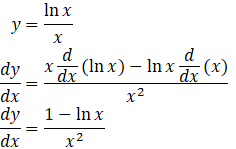
Step 1: Given the function $y = \frac{\ln x}{x}$, we need to find its derivative.
Step 2: We will use the quotient rule for differentiation, which states that if $y = \frac{u}{v}$, then $\frac{dy}{dx} = \frac{u'v - uv'}{v^2}$.
Here, let $u = \ln x$ (thus, $u' = \frac{1}{x}$) and $v = x$ (thus, $v' = 1$).
Step 3: Applying the quotient rule:
$$ \frac{dy}{dx} = \frac{(\frac{1}{x}) x - (\ln x)(1)}{x^2} = \frac{1 - \ln x}{x^2} $$
Therefore, the derivative is $\frac{1 - \ln x}{x^2}$.
Step 2: We will use the quotient rule for differentiation, which states that if $y = \frac{u}{v}$, then $\frac{dy}{dx} = \frac{u'v - uv'}{v^2}$.
Here, let $u = \ln x$ (thus, $u' = \frac{1}{x}$) and $v = x$ (thus, $v' = 1$).
Step 3: Applying the quotient rule:
$$ \frac{dy}{dx} = \frac{(\frac{1}{x}) x - (\ln x)(1)}{x^2} = \frac{1 - \ln x}{x^2} $$
Therefore, the derivative is $\frac{1 - \ln x}{x^2}$.
Prepare Smarter with CGP Edu
Get practice questions, solutions, and test series in one place.
Write a Review
Share your experience with this question and solution.
Commentary
Send your comment, doubt, correction, or feedback to admin.
Similar Questions
Explore conceptually related problems