Published by:
CGP EDU Academic Team
Published on: September 12, 2026
Evaluate the following
(i) 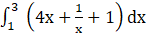
(ii) 
Text Solution
Verified by ExpertsThe correct answer is:
A
Step 1: Evaluate the first integral
We need to find the integral ∫13 (4x + \frac{1}{x} + 1) dx.
Step 1.1: Integrate term by term
The integral can be separated as follows:
∫(4x + \frac{1}{x} + 1) dx = ∫4x dx + ∫\frac{1}{x} dx + ∫1 dx
= 2x^2 + \ln|x| + x + C (where C is the integration constant).
Step 1.2: Evaluate from 1 to 3
We calculate:
[2(3)^2 + \ln(3) + 3] - [2(1)^2 + \ln(1) + 1]
= [18 + \ln(3) + 3] - [2 + 0 + 1] = 21 + \ln(3) - 3 = 18 + \ln(3)
Step 2: Evaluate the second integral
Now, evaluate the integral ∫0\frac{\pi}{4} (\sin x - \cos x) dx.
Step 2.1: Integrate
∫(\sin x - \cos x) dx = -\cos x - \sin x + C
Step 2.2: Evaluate from 0 to \frac{\pi}{4}
We find:
[ -\cos(\frac{\pi}{4}) - \sin(\frac{\pi}{4})] - [-\cos(0) - \sin(0)]
= [-\frac{1}{\sqrt{2}} - \frac{1}{\sqrt{2}}] - [-1 - 0]
= [-\sqrt{2}] + 1
Step 3: Combine the results
The result of (i) is 18 + \ln(3) and the result of (ii) is 1 - \sqrt{2}. Combining gives:
Final result: 18 + \ln(3) + 1 - \sqrt{2} = 19 + \ln(3) - \sqrt{2}.
Therefore, the final answer is summarized as 19 + \ln(3) - \sqrt{2}.
Therefore, A.
We need to find the integral ∫13 (4x + \frac{1}{x} + 1) dx.
Step 1.1: Integrate term by term
The integral can be separated as follows:
∫(4x + \frac{1}{x} + 1) dx = ∫4x dx + ∫\frac{1}{x} dx + ∫1 dx
= 2x^2 + \ln|x| + x + C (where C is the integration constant).
Step 1.2: Evaluate from 1 to 3
We calculate:
[2(3)^2 + \ln(3) + 3] - [2(1)^2 + \ln(1) + 1]
= [18 + \ln(3) + 3] - [2 + 0 + 1] = 21 + \ln(3) - 3 = 18 + \ln(3)
Step 2: Evaluate the second integral
Now, evaluate the integral ∫0\frac{\pi}{4} (\sin x - \cos x) dx.
Step 2.1: Integrate
∫(\sin x - \cos x) dx = -\cos x - \sin x + C
Step 2.2: Evaluate from 0 to \frac{\pi}{4}
We find:
[ -\cos(\frac{\pi}{4}) - \sin(\frac{\pi}{4})] - [-\cos(0) - \sin(0)]
= [-\frac{1}{\sqrt{2}} - \frac{1}{\sqrt{2}}] - [-1 - 0]
= [-\sqrt{2}] + 1
Step 3: Combine the results
The result of (i) is 18 + \ln(3) and the result of (ii) is 1 - \sqrt{2}. Combining gives:
Final result: 18 + \ln(3) + 1 - \sqrt{2} = 19 + \ln(3) - \sqrt{2}.
Therefore, the final answer is summarized as 19 + \ln(3) - \sqrt{2}.
Therefore, A.
Prepare Smarter with CGP Edu
Get practice questions, solutions, and test series in one place.
Write a Review
Share your experience with this question and solution.
Commentary
Send your comment, doubt, correction, or feedback to admin.
Similar Questions
Explore conceptually related problems