A particle is taken to a distance  from centre of the earth. R is radius of the earth. It is given velocity V which is perpendicular to radius. With the given values of V in column-I you have to match the resultant path of particle in column-II. Here ' G ' is the universal gravitational constant and ' M ' is the mass of the earth.
Column-I (Velocity) | Column-II (Path) | ||
(A) | (I) | Elliptical | |
(B) | (II) | Parabolic | |
(C) | (III) | Hyperbolic | |
(D) | (IV) | Circular |

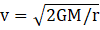
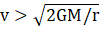

Text Solution
Verified by ExpertsThe correct answer is:
A
Velocity  Path
Path

 Circular

 Elliptical
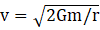
 Parabolic
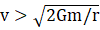
 Hyperbolic
Prepare Smarter with CGP Edu
Get practice questions, solutions, and test series in one place.
Write a Review
Share your experience with this question and solution.
Commentary
Send your comment, doubt, correction, or feedback to admin.
Similar Questions
Explore conceptually related problems
Match List I with List II:
List IList II(A) Kinetic energy of planet(I) (B) Gravitation Potential e…
Match List I with List II:
List IList II(A) Kinetic energy of planet(I) (B) Gravitation Potential e…
is magnitude of physical quantity as a function of r (distance from centre of spherical distributi…
Potential on the surface of a solid sphere is x and radius is y. Match the following two columns.
C…
Match the following two columns.
Column-IColumn-II(A)Work done in raising a mass m to a height (I)(…
Match the following two columns.
Column-IColumn-II(A)Gravitational field strength ismaximum at(I)(B…