The amplitude and phase of a wave that is formed by the superposition of two harmonic travelling waves,  and
and  , are:
(Take the angular frequency of initial waves same as  )
)


Text Solution
Verified by ExpertsB
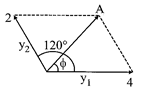
To determine the amplitude and phase of the wave formed by the superposition of the two harmonic traveling waves,  and
and  , we use the
following steps:
First, calculate the resultant amplitude Ausing the formula for the resultant of two waves with different phases:

where:
 (amplitude of the first wave)
 (amplitude of the second wave)
 (phase difference, given by
  ).
).
Substituting the values, we get:
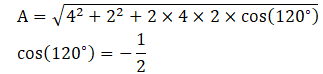
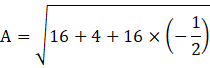
Therefore:
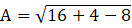
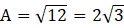
Next, compute the phase  of the resultant wave:
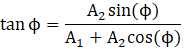
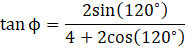

Substituting these values, we get:
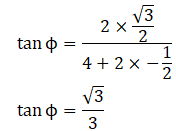
This simplifies to:

Thus, the amplitude and phase of the resultant wave are  and
and  respectively
Prepare Smarter with CGP Edu
Get practice questions, solutions, and test series in one place.
Write a Review
Share your experience with this question and solution.
Commentary
Send your comment, doubt, correction, or feedback to admin.
Similar Questions
Explore conceptually related problems