A player caught a cricket ball of mass 150 g moving at a speed of  . If the catching process is completed in 0.1 s, the magnitude of force exerted by the ball on the hand of the player is:
Text Solution
Verified by ExpertsC
The force exerted by the ball on the hand can be calculated using the formula derived from Newton's second law of motion, which is  , where
  is the force,
  represents the change in momentum, and
  is the time over which this change occurs.
The change in momentum,  , can be calculated as the difference between the final momentum,
  , and the initial momentum,
  . In this scenario, because the ball comes to a stop in the player's hand, its final velocity (and hence, its final momentum) is 0 . Therefore, the change in momentum is equal to the initial momentum of the ball (since final momentum is zero).
The initial momentum,  , of the ball can be calculated using the formula
  , where
  is the mass of the ball and
  is its velocity. Given that the mass of the ball is
 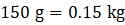 (converting grams to kilograms) and its velocity is
  , we have:

Since the change in momentum,  , equals the initial momentum (
  ) because the final momentum is 0, the force exerted can be found by substituting
  and
and  into the first formula:
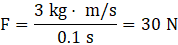
Therefore, the magnitude of force exerted by the ball on the hand of the player is 30 N, which corresponds to Option C.
Prepare Smarter with CGP Edu
Get practice questions, solutions, and test series in one place.
Write a Review
Share your experience with this question and solution.
Commentary
Send your comment, doubt, correction, or feedback to admin.
Similar Questions
Explore conceptually related problems