Published by:
CGP EDU Academic Team
Published on: September 12, 2026
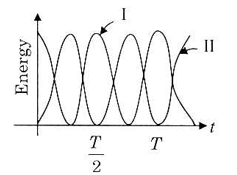
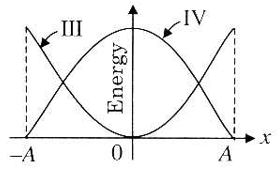
The displacement of a linear harmonic oscillator is given by x = A cos ω t. The curves showing the variation of the potential energy with t and x (see figure) are displayed respectively by:
Text Solution
Verified by ExpertsThe correct answer is:
A
Potential energy is minimum (in this case zero) at mean position (x ∝ 0) and maximum at extreme positions (x = ± A)
At time t = 0, x = A. Hence P.E. should be maximum. Therefore graph I is correct.
Further in graph III, P.E. is minimum at x = 0. Hence this is also correct.
Prepare Smarter with CGP Edu
Get practice questions, solutions, and test series in one place.
Write a Review
Share your experience with this question and solution.
Commentary
Send your comment, doubt, correction, or feedback to admin.
Similar Questions
Explore conceptually related problems
Two particles execute S.H.M. of same amplitude and frequency along the same straight line from same…
A block of mass m is resting on a piston which is moving vertically with a SHM of period 1 s. The m…
A point particle of mass 0.1 kg is executing S.H.M. of amplitude of 0.1 m. When the particle passes…
Acceleration a versus time t graph of a body in SHM is given by a curve shown below. T is the time …
A particle executes simple harmonic motion with a frequency v. The frequency with which the kinetic…
When an oscillator completes 100 oscillation its amplitude reduced to of initial value. What will …