Published by:
CGP EDU Academic Team
Published on: September 13, 2026
The electric potential decreases uniformly from 180 V to 20 V as one moves on the X-axis from
x = – 2 cm to x = + 2 cm. The electric field at the origin:
Text Solution
Verified by ExpertsThe correct answer is:
CHECK THE SOLUTION.
(b, c)
from given data E x =  V/cm = 40 V/cm
but E = 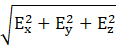
⇒ E may be equal or greater than 40 V/cm ie.
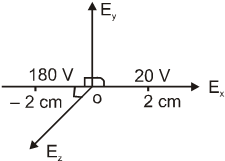
As shown, there can be electric fields ⊥ to x axis, which will not affect the electric potential difference but can increase net field.
Prepare Smarter with CGP Edu
Get practice questions, solutions, and test series in one place.
Write a Review
Share your experience with this question and solution.
Commentary
Send your comment, doubt, correction, or feedback to admin.
Similar Questions
Explore conceptually related problems
A charge q is placed at the center of the line joining two equal charges Q. The system of the three…
Inside a hollow charged spherical conductor, the potential
Two small spheres each carrying a charge q are placed r meter apart. If one of the spheres is taken…
The electric charge in uniform motion produces
Two charged spheres of radii 10 cm and 15 cm are connected by a thin wire. No current will flow, if…
The electric field inside a spherical shell of uniform surface charge density is