Published by:
CGP EDU Academic Team
Published on: September 12, 2026
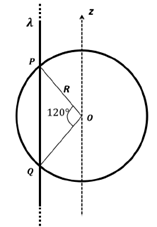
An infinitely long thin non-conducting wire is parallel to the z-axis and carries a uniform line charge density λ. It pierces a thin non-conducting spherical shell of radius R in such a way that the arc PQ subtends an angle 120° at the center O of the spherical shell, as shown in the figure. The permittivity of free space is ε 0 . Which of the following statements is (are) true?
A
The electric flux through the shell is 
B
The z-component of the electric field is zero at all the points on the surface of the shell
C
The electric flux through the shell is 
D
The electric field is normal to the surface of the shell at all points
Text Solution
Verified by ExpertsThe correct answer is:
CHECK THE SOLUTION.
(a, b)
Sol. Q enc = λ  R
R
φ φ = 
Prepare Smarter with CGP Edu
Get practice questions, solutions, and test series in one place.
Write a Review
Share your experience with this question and solution.
Commentary
Send your comment, doubt, correction, or feedback to admin.
Similar Questions
Explore conceptually related problems
Assume that an electric field exists in space. Then the potential difference V A – V O , where V O…
A long cylindrical shell carries positive surface charge σ in the upper half and negative surface c…
An electric dipole has a fixed dipole moment , which makes angle θ with respect to x-axis. When su…
<p>Three concentric metal shells A, B and C of respective radii a, b and c (a < b < c) have s…
Assume that an electric field exists in space. Then the potential difference V A – V O , where V O…
An electric dipole has a fixed dipole moment , which makes angle θ with respect to x-axis. When su…