The electric field E is measured at a point P(0, 0, d) generated due to various charge distributions and the dependence of E on d is found to be different for different charge distributions. List-I contains different relations between E and d. List-II describes different electric charge distributions, along with their locations. Match the functions in List-I with the related charge distributions in List-II.
List-I | List-II | ||
P. | E is independent of d | 1. | A point charge Q at the origin |
Q. | E µ 1/d | 2. | A small dipole with point charges Q at (0, 0, l) and –Q at (0, 0, –l) Take 2l << d |
R. | E µ 1/d2 | 3. | An infinite line charge coincident with the x-axis, with uniform linear charge density l. |
S. | E µ 1/d3 | 4. | Two infinite wires carrying uniform linear charge density parallel to the x-axis. The one along (y = 0, z = l) has a charge density +l and the one along (y = 0, z = –l) has a charge density –l. Take 2l << d |
5. | Infinite plane charge coincident with the xy-plane with uniform surface charge density. |
Text Solution
Verified by ExpertsB
in case of point charge E = 
In case of dipole E = 
For an infinite long line charge E = 
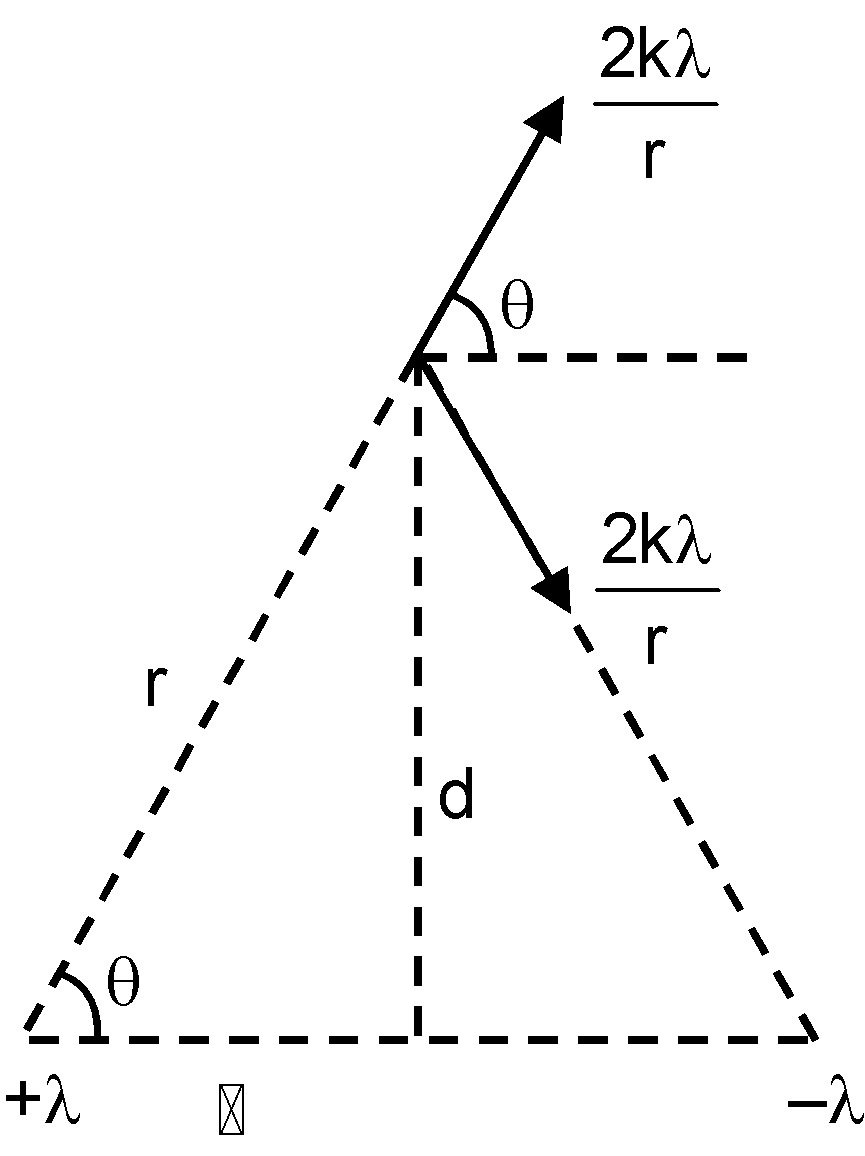
E = 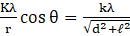 =
=  =
=  ~
~ 
Prepare Smarter with CGP Edu
Get practice questions, solutions, and test series in one place.
Write a Review
Share your experience with this question and solution.
Commentary
Send your comment, doubt, correction, or feedback to admin.
Similar Questions
Explore conceptually related problems