(i) Three equal charges q 0 each are placed at three corners of an equilateral triangle of side 'a'. Find out force acting on one of the charge due to other two charges?
(ii) In the above question, if one of the charge is replaced by negative charge then find out force acting on it due to other charges?
(iii) Repeat the part (i) if magnitude of each charge is doubled and side of triangle is reduced to half.
Text Solution
Verified by Experts(i) , away from the charges along perpendicular bisector of line joining remaining two charges; (ii) ; (iii) ; (i) F 1 ; (ii) F 1 ; (iii) F 1
(i)  , away from the charges along perpendicular bisector of line joining remaining two charges.
(ii)  ; towards the charges along perpendicular bisector of line joining remaining two charges.
(iii)  ; away from the charges along angle bisector.
Sol. (i)
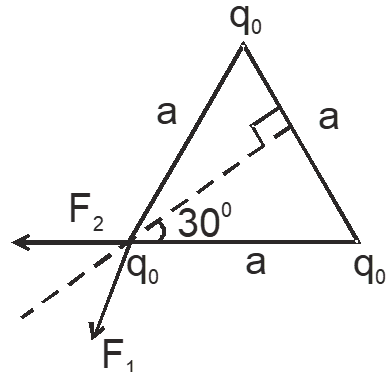
F 1 = F 2 = 
F = F 1 cos30 0 + F 2 cos30 0
= 2F 1 cos30 0
∴ F = F 1 
or F =  ,away from the charges along perpendicular bisector of line joining remaining two charges.
(ii)
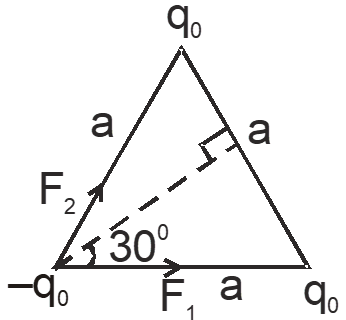
F 1 = F 2 = 
F = F 1 cos30 0 + F 2 cos30 0 = 2F 1 cos30 0 = F 1 
=  towards the charges along perpendicular bisector of line joining remaining two charges.
(iii)
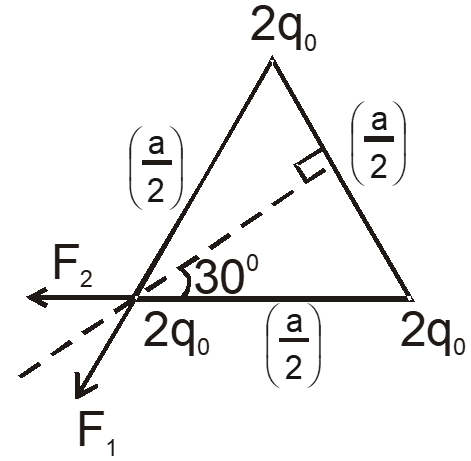
F 1 = F 2 =  =
= 
F = F 1 cos30 0 + F 2 cos30 0
= 2F 1 cos30 0
= F 1 
= 
=  away from the charges along angle bisector.
Prepare Smarter with CGP Edu
Get practice questions, solutions, and test series in one place.
Write a Review
Share your experience with this question and solution.
Commentary
Send your comment, doubt, correction, or feedback to admin.
Similar Questions
Explore conceptually related problems