A copper rod (initially at room temperature 20°C) of non-uniform cross section is placed between a steam chamber at 100°C and ice-water chamber at 0°C
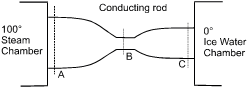
(a) | Initially rate of heat flow will be | (p) | maximum at section A |
(b) | At steady state rate of heat flow will be | (q) | maximum at section B |
(c) | At steady state temperature gradient will be | (r) | minimum at section A |
(d) | At steady state rate of change of temperature at a certain point will be | (s) | minimum at section B |
(t) | same for all section |


Text Solution
Verified by Expertsp, s t q, r t
Sol. Initially more heat will enter through section A due to temperature difference and no heat will flow through section B because initially there is no temperature difference.
At steady state rate of heat flow  is same for all sections
At steady state  = kA
= kA  or
or  =
= 
 is inversely proportional to area of cross-section. Hence is maximum at B and minimum at A At steady state heat accumulation = 0
So  = 0 for any section.
Prepare Smarter with CGP Edu
Get practice questions, solutions, and test series in one place.
Write a Review
Share your experience with this question and solution.
Commentary
Send your comment, doubt, correction, or feedback to admin.
Similar Questions
Explore conceptually related problems