A particle free to move along the x-axis has potential energy given by U(x) = k[  ]
]
for -∞  x
x  + ∞, where k is a positive constant of appropriate dimensions. Then select the incorrect options:
Text Solution
Verified by ExpertsCHECK THE SOLUTION.
(a, b, c)
U (x) = 
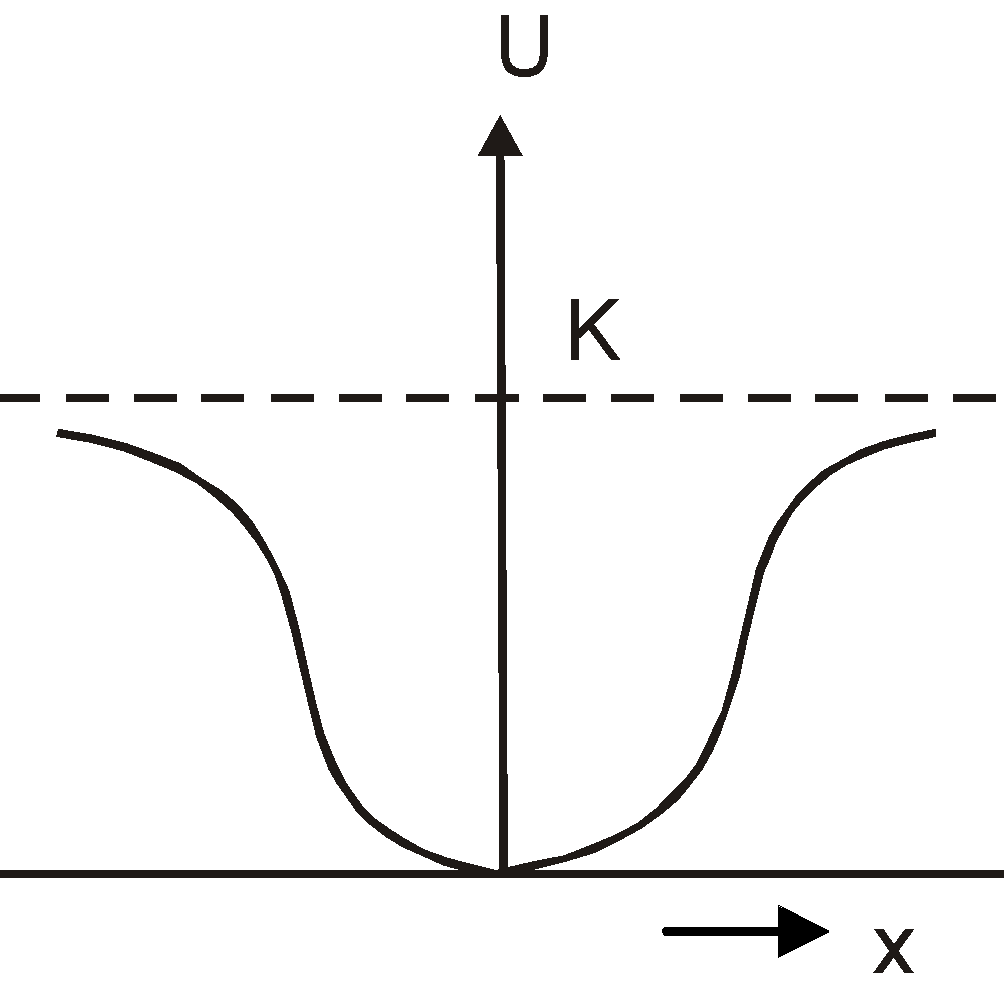
It is an exponentially increasing graph of potential energy (U) with x 2 . Therefore U versus x graph will be as shown.
From the graph it is clear that at origin
Potential energy U is minimum (therefore, kinetic energy will be maximum) and force acting on the particle is also zero because F =  = –(slope of U – x graph ) = 0.
Therefore, origin is the stable equilibrium position. Hence particle will oscillate simple harmonically about x = 0 for small displacements. Therefore, correct option is .
At equilibrium position F =  = 0 i.e. slope of U-X graph should be zero and from the graph we can see that slope is zero at x = 0 and x = ± ∞. Now among these equilibriums stable equilibrium position is that where U is minimum (Here x = 0). Unstable equilibrium position is that where U is maximum (Here none). Neutral equilibrium position is that where U is constant (Here x = ± ∞). Therefore, option is wrong.
For any finite non-zero value of x, force is directed towards the origin, because origin is in stable equilibrium position. Therefore, option is incorrect.
At origin, potential energy is minimum, hence kinetic energy will be maximum. Therefore, option is also wrong.
Prepare Smarter with CGP Edu
Get practice questions, solutions, and test series in one place.
Write a Review
Share your experience with this question and solution.
Commentary
Send your comment, doubt, correction, or feedback to admin.
Similar Questions
Explore conceptually related problems