Two identical balls A and B, each of mass 0.1 kg, are attached to two identical mass less springs. The spring–mass system is constrained to move inside a rigid smooth pipe bent in the form of a circle as shown in the figure. The pipe is fixed in a horizontal plane. The centres of the balls can move in a circle of radius 0.06 m. Each spring has a natural length of 0.06 π metre and spring constant 0.1 N/m. Initially, both the balls are displaced by an angle θ = π / 6 radian with respect to the diameter PQ of the circle (as shown in fig.) and released from rest.
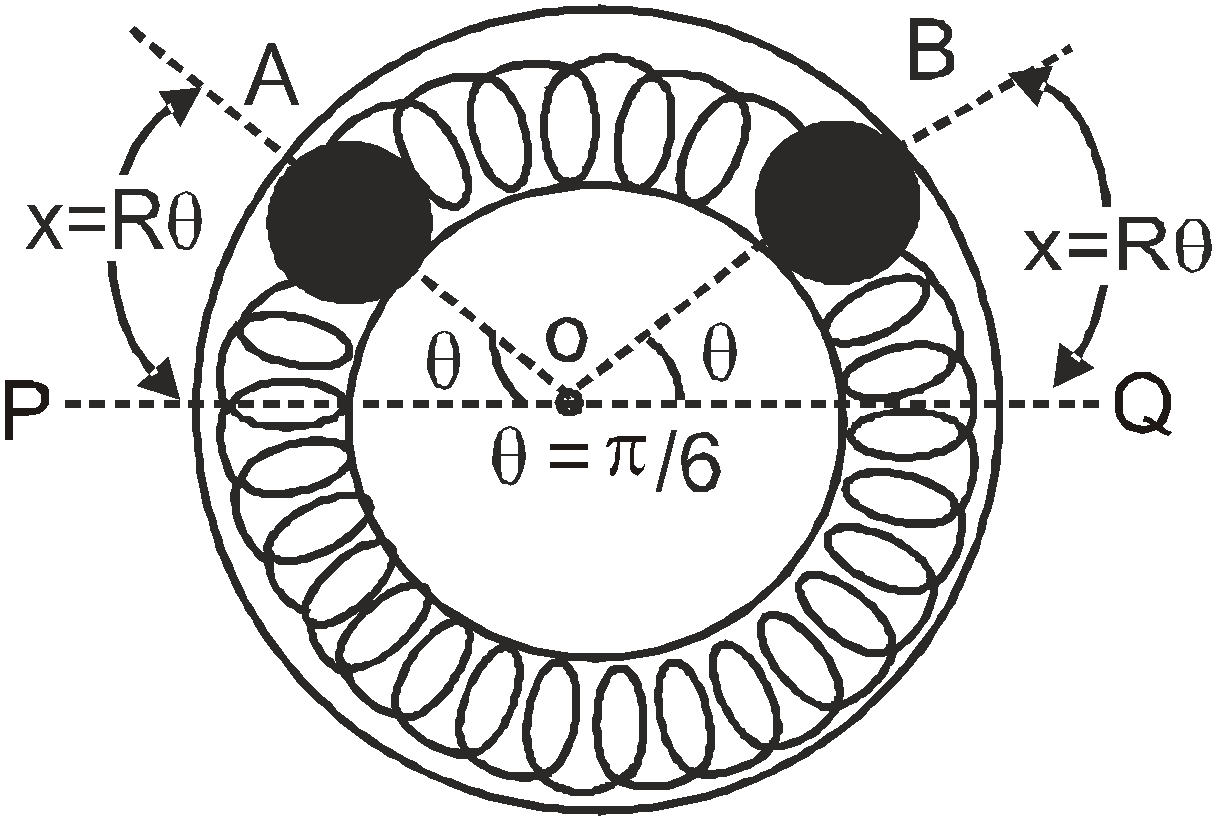
(i) Calculate the frequency of oscillation of ball B.
(ii) Find the speed of ball A when A and B are at the two ends of the diameter PQ.
(iii) What is the total energy of the system?
Text Solution
Verified by ExpertsA
[ f = 
 =
=  Hz
Hz
(ii) V = 0.0628
(iii) 3.9 × 10 –4 J]
Given – Mass of each block A and B, m = 0.1kg
Radius of circle, R = 0.06 m
Natural length of spring λ 0 = π R = 0.06 π (Half circle)
and spring constant, k = 0.1 N/m
In the stretched position elongation in each spring
x = R θ .
Let us draw FBD of A
x = R θ .
A dk FBD
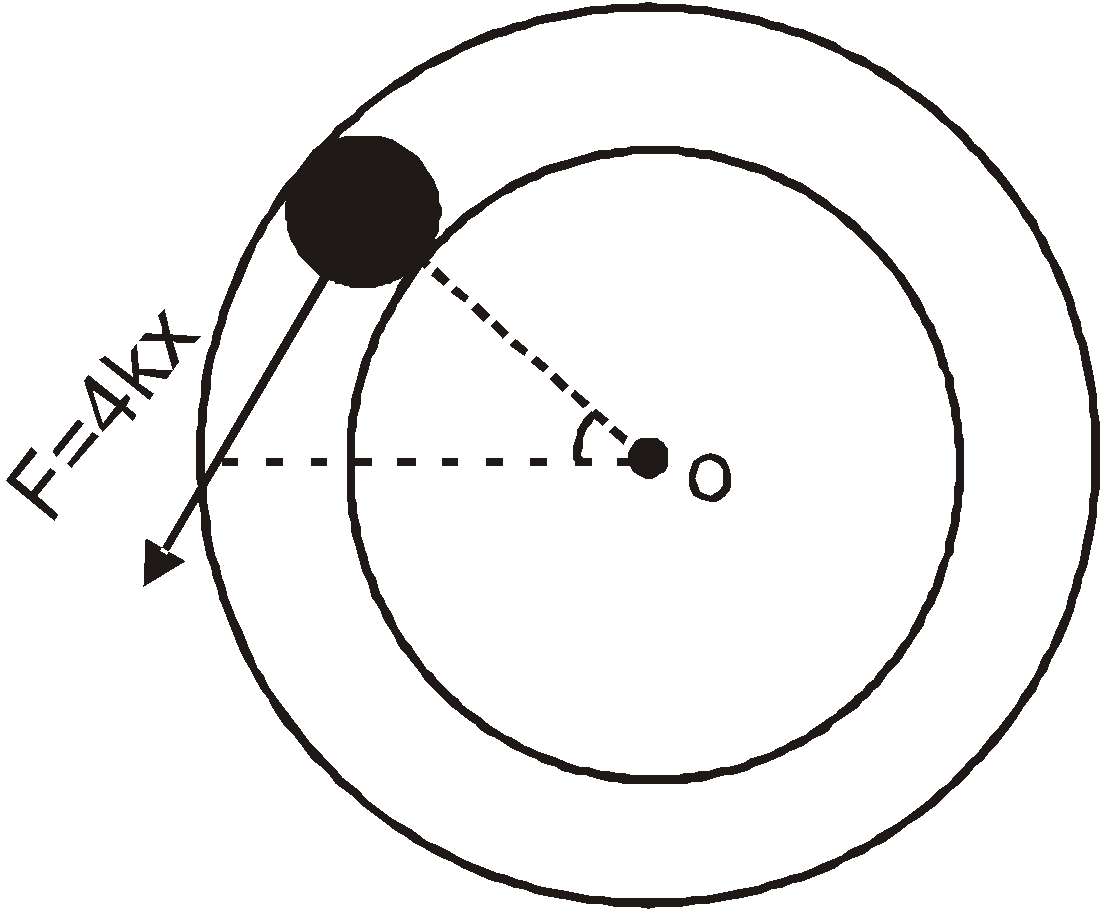
Spring in lower side is stretched by 2x and on upper side compressed by 2x. Therefore, each spring will exert a force 2kx on each ball.
Hence, a restoring force, F = 4kx will act on A in the direction shown in figure.
Restoring torque of this force about origin
τ = – F. R = – (4kx) R = – (4kR θ ) R
or τ = – 4kR 2 . θ ...........(1)
Since, τ ∝ – θ , each ball executes angular SHM about origin O.
Eq. (1) can be rewritten as
I α = – 4kR 2 θ
or ( mR 2 ) α = – 4kR 2 θ
or α = –  θ
θ
∴ Frequency of oscillation, f = 

 =
= 

f = 

Substituting the values, we have
f = 
 =
=  Hz
Hz
Prepare Smarter with CGP Edu
Get practice questions, solutions, and test series in one place.
Write a Review
Share your experience with this question and solution.
Commentary
Send your comment, doubt, correction, or feedback to admin.
Similar Questions
Explore conceptually related problems