Published by:
CGP EDU Academic Team
Published on: September 12, 2026
A stone falls freely such that the distance covered by it in the last second of its motion is equal to the distance covered by it in the first  . It is in air for
  s.
s.
Text Solution
Verified by ExpertsThe correct answer is:
B
Distance covered by the stone in  is
is
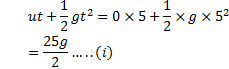
Since, distance travelled in nth second is given by
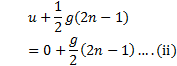
 As
As  ]
]
equating eq  (i) & (ii)
 is also last second here
Prepare Smarter with CGP Edu
Get practice questions, solutions, and test series in one place.
Write a Review
Share your experience with this question and solution.
Commentary
Send your comment, doubt, correction, or feedback to admin.
Similar Questions
Explore conceptually related problems
The velocity (v) of a particle starting from rest increases linearly withtime (t) as , where is i…
If the engine of a long train moving with constant acceleration crosses a tree with velocity ' ' a…
If a person moving along a straight line path covers first half distance with velocity ' ' and the…
If the velocity of a particle moving along a straight line with uniform acceleration, is given by …
Two bodies of masses ' ' and ' ' are dropped from two different heights and respectively. The r…
A person walks up a stalled escalator in . When standing on the same escalator, now moving, he is …