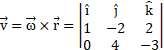
The linear velocity of a rotating body is given by  where
where  is the angular velocity and
  is the radius vector. The angular velocity of a body is
  and the radius vector
  then
then  is
is
A
 units
units
B
 units
units
C
 units
units
D
 units
units
Text Solution
Verified by ExpertsThe correct answer is:
A


Prepare Smarter with CGP Edu
Get practice questions, solutions, and test series in one place.
Write a Review
Share your experience with this question and solution.
Commentary
Send your comment, doubt, correction, or feedback to admin.
Similar Questions
Explore conceptually related problems
If a vector is perpendicular to the vector . Then the value of is
If two vectors and are parallel to each other then value of l λ be
A body, acted upon by a force of 50 N is displaced through a distance 10 meter in a direction makin…
A particle moves from position to due to a uniform force of If the displacement in meters then w…
If for two vector and , sum is perpendicular to the difference . The ratio of their magnitude is
The angle between the vectors and is The value of the triple product is