The displacement  of a particle varies with time
  , where
  are positive constants. The velocity of the particle will
A
Go on decreasing with time
B
Be independent of  and
and 
and
C
Drop to zero when 
D
Go on increasing with time
Text Solution
Verified by ExpertsThe correct answer is:
D

Velocity 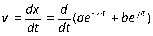


Acceleration 

Acceleration is positive so velocity goes on increasing with time.
Prepare Smarter with CGP Edu
Get practice questions, solutions, and test series in one place.
Write a Review
Share your experience with this question and solution.
Commentary
Send your comment, doubt, correction, or feedback to admin.
Similar Questions
Explore conceptually related problems
A particle experiences a constant acceleration for 20 sec after starting from rest. If it travels a…
The displacement of a particle along a straight line at time is given by . The acceleration of t…
The coordinates of a moving particle at any time are given by and . The speed of the particle at …
An electron starting from rest has a velocity that increases linearly with the time that is where …
The displacement of a body is given to be proportional to the cube of time elapsed. The magnitude o…
A body is moving from rest under constant acceleration and let be the displacement in the first s…