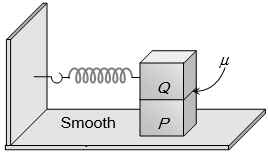
A block P of mass m is placed on a frictionless horizontal surface. Another block Q of same mass is kept on P and connected to the wall with the help of a spring of spring constant k as shown in the figure. µ s is the coefficient of friction between P and Q. The blocks move together performing SHM of amplitude A. The maximum value of the friction force between P and Q is



Text Solution
Verified by ExpertsB
When two blocks perform simple harmonic motion together then at the extreme position (at amplitude  ) Restoring force
There will be no relative motion between P and Q if pseudo force on block P is less than or just equal to limiting friction between P and Q.
i.e.  Limiting friction
 Maximum friction
Prepare Smarter with CGP Edu
Get practice questions, solutions, and test series in one place.
Write a Review
Share your experience with this question and solution.
Commentary
Send your comment, doubt, correction, or feedback to admin.
Similar Questions
Explore conceptually related problems