Suppose the gravitational force varies inversely as the  power of distance. Then the time period of a planet in circular orbit of radius R around the sun will be proportional to
A

B

C

D

Text Solution
Verified by ExpertsThe correct answer is:
A
 ⇒ ⇒
⇒ ⇒ 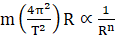 ⇒ ⇒
⇒ ⇒ 
∴ ∴ 
Prepare Smarter with CGP Edu
Get practice questions, solutions, and test series in one place.
Write a Review
Share your experience with this question and solution.
Commentary
Send your comment, doubt, correction, or feedback to admin.
Similar Questions
Explore conceptually related problems
Imagine a light planet revolving around a very massive star in a circular orbit of radius R with a …
A satellite S is moving in an elliptical orbit around the earth. The mass of the satellite is very …
A mass M is split into two parts, m and (M–m), which are then separated by a certain distance. What…
In order to make the effective acceleration due to gravity equal to zero at the equator, the angula…
A simple pendulum has a time period when on the earth’s surface and when taken to a height R abov…
A rocket of mass M is launched vertically from the surface of the earth with an initial speed V. As…