In order to make the effective acceleration due to gravity equal to zero at the equator, the angular velocity of rotation of the earth about its axis should be 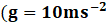 and radius of earth is 6400 kms)
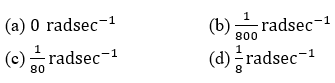
Text Solution
Verified by ExpertsThe correct answer is:
B

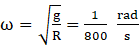
For weightlessness at equator  and
and 
∴ ∴  ⇒ ⇒
⇒ ⇒ 
Prepare Smarter with CGP Edu
Get practice questions, solutions, and test series in one place.
Write a Review
Share your experience with this question and solution.
Commentary
Send your comment, doubt, correction, or feedback to admin.
Similar Questions
Explore conceptually related problems
Imagine a light planet revolving around a very massive star in a circular orbit of radius R with a …
A satellite S is moving in an elliptical orbit around the earth. The mass of the satellite is very …
A mass M is split into two parts, m and (M–m), which are then separated by a certain distance. What…
Suppose the gravitational force varies inversely as the power of distance. Then the time period of…
A simple pendulum has a time period when on the earth’s surface and when taken to a height R abov…
A rocket of mass M is launched vertically from the surface of the earth with an initial speed V. As…