The kinetic energy and potential energy of a particle executing simple harmonic motion will be equal, when displacement (amplitude = a) is
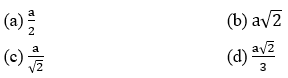
Text Solution
Verified by ExpertsThe correct answer is:
C
Suppose at displacement y from mean position potential energy = kinetic energy

⇒ ⇒  ⇒ ⇒
⇒ ⇒ 
Prepare Smarter with CGP Edu
Get practice questions, solutions, and test series in one place.
Write a Review
Share your experience with this question and solution.
Commentary
Send your comment, doubt, correction, or feedback to admin.
Similar Questions
Explore conceptually related problems
Which of the following is a necessary and sufficient condition for S.H.M.
A particle executes simple harmonic motion along a straight line with an amplitude A. The potential…
A particle is vibrating in a simple harmonic motion with an amplitude of 4 cm. At what displacement…
For a particle executing simple harmonic motion, the kinetic energy K is given by . The maximum va…
The potential energy of a particle with displacement X is U(X). The motion is simple harmonic, when…
The total energy of the body executing S.H.M. is E. Then the kinetic energy when the displacement i…