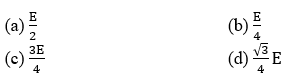
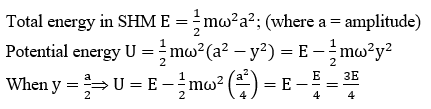
The total energy of the body executing S.H.M. is E. Then the kinetic energy when the displacement is half of the amplitude, is
Text Solution
Verified by ExpertsThe correct answer is:
C
Prepare Smarter with CGP Edu
Get practice questions, solutions, and test series in one place.
Write a Review
Share your experience with this question and solution.
Commentary
Send your comment, doubt, correction, or feedback to admin.
Similar Questions
Explore conceptually related problems
Which of the following is a necessary and sufficient condition for S.H.M.
A particle executes simple harmonic motion along a straight line with an amplitude A. The potential…
A particle is vibrating in a simple harmonic motion with an amplitude of 4 cm. At what displacement…
For a particle executing simple harmonic motion, the kinetic energy K is given by . The maximum va…
The potential energy of a particle with displacement X is U(X). The motion is simple harmonic, when…
The kinetic energy and potential energy of a particle executing simple harmonic motion will be equa…