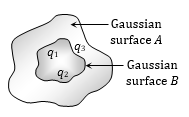
The electric flux for Gaussian surface A that enclose the charged particles in free space is (given q 1 = –14 nC, q 2 = 78.85 nC, q 3 = – 56 nC)
Text Solution
Verified by ExpertsThe correct answer is:
A
Flux is due to charges enclosed per 
∴ ∴ Total flux = 

 i..e.
i..e. 
Prepare Smarter with CGP Edu
Get practice questions, solutions, and test series in one place.
Write a Review
Share your experience with this question and solution.
Commentary
Send your comment, doubt, correction, or feedback to admin.
Similar Questions
Explore conceptually related problems
A cylinder of radius R and length L is placed in a uniform electric field E parallel to the cylinde…
Electric field at a point varies as for
An electric charge q is placed at the center of a cube of side α. The electric flux on one of its f…
Total electric flux coming out of a unit positive charge put in air is
For a given surface the Gauss's law is stated as . From this we can conclude that
A cube of side l is placed in a uniform field E, where . The net electric flux through the cube is