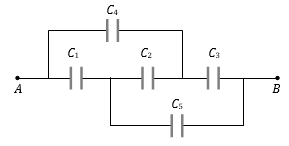
In the given figure the capacitors  have a capacitance 4 μ μ F each if the capacitor C 2 has a capacitance 10 μ μ F, then effective capacitance between A and B will be
Text Solution
Verified by ExpertsB
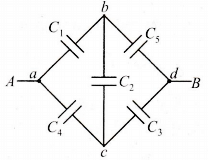
Capacitance of capacitors  each and capacitance of capacitor
  . If a battery is applied across A and B , the points b and c will be at the same potential (since
  ).
).
Therefore no charge flows through  .
.
We have the capacitors  and
and  in series. Therefore their equivalent capacitance,
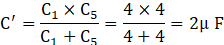
Similarly,  and
and  are in series. Therefore their equivalent capacitance,

Now  and
and  are in parallel. Therefore effective capacitance between A and
Prepare Smarter with CGP Edu
Get practice questions, solutions, and test series in one place.
Write a Review
Share your experience with this question and solution.
Commentary
Send your comment, doubt, correction, or feedback to admin.
Similar Questions
Explore conceptually related problems